
Autumn Dispatch from the Order of the Great Fifth Sea
Summer has begun its withdrawal from the western shore.
The beaches have quieted. The mornings are cooler. The lake has resumed the darker complexion that generally precedes several months of poor decisions involving wind.
Before autumn operations begin in earnest, the Rawley Point Chapter House offers the following account of the summer season.
A Summer of Field Work
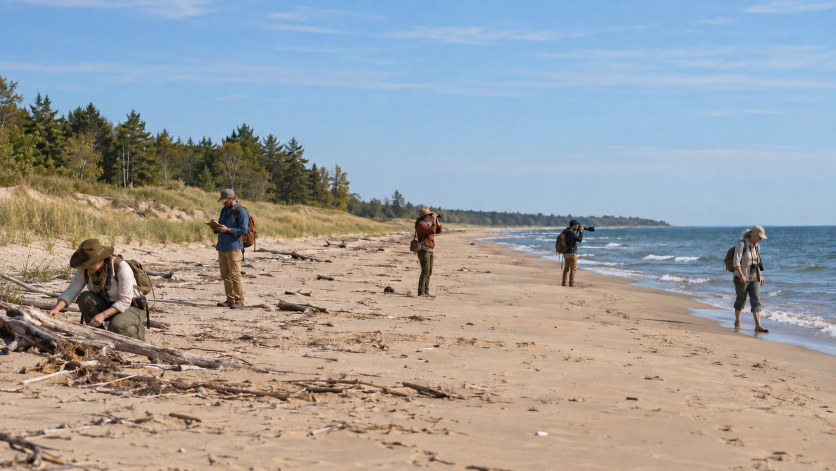
The warmer months allowed members to return to routine shoreline work around Rawley Point, Two Rivers, Point Beach, and adjoining stretches of the western littoral.
Most of this work was appropriately uneventful.
Sites were photographed. Bearings were recorded. Shoreline changes were noted. Objects were examined and, in several cases, correctly identified as ordinary rocks.
This represents measurable progress.
The work also provided an opportunity to revisit locations associated with earlier Order records, including the ground involved in the Rawley Point Affair, an episode which remains instructive regarding the dangers of contractual language, institutional pride, and attempting to bribe representatives of the Great Lakes Research Consortium with collectible cards.
Instruction at the Chapter House
Several informal workshops were held at the Rawley Point Chapter House during the summer.
Subjects included historical chart reading, shoreline documentation, field photography, compass work, archival handling, and the proper preparation of a field notebook before somebody writes coffee measurements in it.
One evening was devoted almost entirely to comparing historic maps with contemporary shoreline observations.
This produced several useful corrections to the working record and one unresolved notation that will remain unresolved until somebody produces better evidence.
No committee has yet been formed.
This is considered encouraging.
The Door County Presentation
The Order also made a rare venture into public instruction when Presiding Concordant Alistar Corvus presented recent work before a gathering in Door County.
The presentation employed a Kodak Carousel projector, a modern projector supplied by the Great Lakes Research Consortium, and the Order's official Gateway Pentium 5 computer.
The Gateway performed without incident.
The same cannot be said for the presentation remote.
Topics included shoreline history, recent field observations, archival research, and the continuing difficulty of separating historical evidence from stories that have simply been repeated for a very long time.
Questions followed.
Some were useful.
The Obadiah Letter
The summer's most consequential archival discovery was a previously uncatalogued letter attributed to Obadiah Flint, Founder Keeper Emeritus.
Dated 1884, the document predates several events traditionally associated with the Order and provides an unusual glimpse into Flint's thinking during the period in which many of the ideas later embodied by the Order appear to have been taking shape.
It offers no prophecy and no convenient explanation.
This has increased its credibility considerably.
Klara completed the transcription.
Alistar located the document.
Both facts have been preserved in the record, principally because Alistar has insisted upon it.
The letter has since been returned to protected storage while related material is examined.
Experimental Littoral Operations
Summer also saw the resumption of experimental shallow-water work along the lake.
The most visible portion involved Edwin Barlow and a configuration of vintage diving equipment incorporating a surface air line, traditional helmet, weighted apparatus, and spearfishing equipment.
The exercise was intended to evaluate whether historically derived equipment and methods could remain useful during controlled modern shoreline operations.
The answer appears to be:
Technically, yes.
This conclusion should not be interpreted as authorization to repeat the exercise without further review.
The Lake Remains Difficult
Summer conditions also provided additional opportunities to document the atmospheric and nearshore phenomena that remain central to the Order's study of the Fifth Sea.
Among these are seiches, sudden water-level fluctuations, storm-driven shoreline change, and the less widely understood phenomenon of the Great Lakes meteotsunami.
The latter has been examined previously in the Order's paper Meteotsunamis in the Laurentian Great Lakes, which argues, with unusual restraint, that a large inland body of water capable of moving unexpectedly should perhaps be treated with respect.
Meteotsunamis in the Laurentian Great Lakes
Autumn Operations
Autumn is traditionally among the more useful seasons for field documentation.
Recreational traffic diminishes. Vegetation recedes. Storm systems strengthen. Shoreline profiles change.
Accordingly, field operations will continue as conditions permit.
Particular attention will be given to post-storm shoreline surveys, erosion, exposed material, unusual water-level events, and comparison photography at established observation points.
Members are reminded that the appearance of an object following a storm does not establish historical significance.
Neither does enthusiasm.
Instruments and Records
Autumn will also begin the annual inspection of field equipment before winter storage.
Compasses will be checked.
Optics will be cleaned.
Weather instruments will be compared.
Canvas equipment will be aired.
Any device described by its owner as “probably still waterproof” will be tested somewhere other than the archive.
The Chapter House will also begin processing the summer field record into the Aligned Ledger, along with photographs, maps, notes, correspondence, and items currently awaiting classification.
This work is less photogenic than field operations.
It is also considerably more important.
Winter Operations
The first sustained cold traditionally marks the Order's return from the shoreline to the archive.
Winter work will concentrate on the Flint material, unresolved summer records, historical charts, maritime correspondence, and several boxes whose labels have ceased to provide meaningful information.
Research related to Great Lakes wrecks and early navigation will also continue, including subjects already represented in the AOP record such as Le Griffon's enduring disappearance and the historical traditions surrounding Lake Michigan's lost vessels.
Tracing the Fate of Le Griffon's Figurehead
Limited winter field observations will continue when conditions warrant.
No expedition is improved merely by being colder.
This principle has been entered into the record before.
The Season Turns
There remain matters from summer that require further attention.
The Obadiah letter has raised questions rather than answered them.
Several shoreline locations require comparison after the autumn storms.
The diving apparatus requires inspection.
And at least one map remains on the long table at Rawley Point because nobody has yet been willing to admit that the mark under discussion may simply be a stain.
For now, the summer equipment is being brought in.
The beaches are emptying.
The first hard winds are beginning to arrive from the lake.
The Order remains at its post.