
Silent Circle Survey
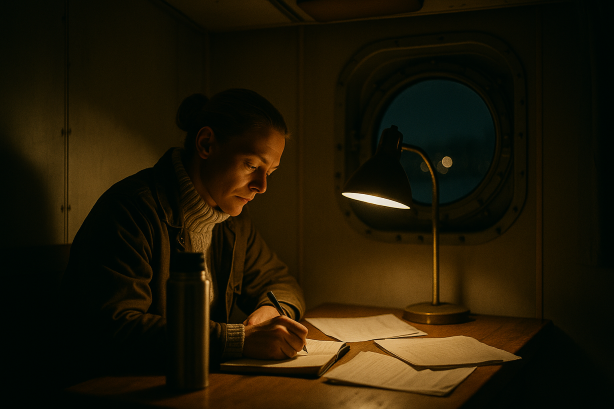
Personal Log – Klara Nilsen
(Aboard Arcturus, Grand Traverse Bay, 22–23 October 2025)
The lake this morning looked indecisive — no wind, no ripple, no color. Just that dull metallic calm that makes even the gulls rethink their schedule. The Arcturus floated at Pier 5 like an idea that hadn’t committed to being real yet.
We launched at 07:40.
The GLRC crew ran their safety checks in the usual orderly panic. The Order contingent followed Alistar’s preferred sequence: formal silence, three deep breaths, and something halfway between prayer and preamble.
I recorded both, since omitting either would later be described as bias.
By 09:07, the Little Concord was in the water. It slipped beneath the surface like it knew the way home.
Charts watched from the winch deck, his face doing that thing where it tries to hide awe under logistics. Rebecca observed from the bridge, expression fixed in “supervisor neutral.” Alistar hovered between them, an unhelpful constellation of conviction.
For a while, everything behaved: comms steady, telemetry stable, pressure consistent. The lake almost looked hospitable.
At 09:39, both systems failed.
Not one, not intermittent — both.
Digital and analog, signal and pencil, faith and fiber optics — every channel flattened into silence for six seconds. I logged it as “simultaneous interruption.” I did not log that my hands shook.
It wasn’t darkness exactly. It was pressure — the kind of silence that sits on the bones. Even the hull stopped complaining. Barlow whispered, “Perhaps the lake needed to speak.”
No one corrected him. Possibly because it felt impolite to interrupt the lake.
The feed returned as abruptly as it left. Rebecca called it “magnetic interference.” Alistar called it “reciprocal attention.” Charts didn’t call it anything — just started sketching like a man racing a thought.
At 10:15, the Little Concord surfaced.
That’s when the weather decided to object.
The sky folded in on itself, clouds forming faster than they should, the air changing from still to shoving in the space of a minute.
Winds tore across the bay; the lake turned from glass to claws.
Great Lakes storms usually telegraph their intent — pressure drops, the smell of metal, a warning line across the horizon. This one didn’t. It simply appeared, as if summoned by recognition.
Rain came sideways. The hull trembled. Rebecca shouted commands that were pure science under pressure. Alistar stood motionless at the port window, looking like he expected revelation.
I secured the ledgers, which seemed like the most human reaction available.
Charts stumbled into the cabin soaked, clutching his waterproof notebook like a relic. Inside, his sketch — a curved alignment of stones, one marked darker than the rest, circled over and over until the paper thinned.
“What’s that mark?” I asked.
“The echo,” he said.
“What echo?”
He hesitated. “The one that waited to be found.”
The storm lasted forty minutes. We logged nothing. There’s no calibration for a storm that arrives as punctuation.
By the time it passed, the lake had reverted to its bureaucratic calm, as if someone had filed a complaint. The GLRC crew resumed their precision. The Order resumed their mythology. I dried the ledgers with a heat lamp and pretended the world was still measurable.
I woke early this morning — the ship rocking gently, the kind of deceptive peace that follows when chaos gets tired.
The data cabin smelled of damp coffee and denial. I ran diagnostics on the corrupted recordings.
Drive 3C, the one that died mid-dive, plays a low rhythmic pattern beneath the static. Four seconds in, four seconds out — steady, deliberate, too regular for noise. It sounds like breathing.
I replayed it until I couldn’t decide if it was real.
Charts found me there, eyes red, still half in the storm.
“You’re looping it,” he said.
“I’m verifying interference.”
He smiled, the kind of smile that forgives you for lying.
“Does it ever stop sounding like breathing?”
“No,” I said. “But I’m labeling it as feedback.”
“Good,” he said. “That’s what I labeled it too.”
We let it play once more, then shut it off together. The silence that followed felt alive.
Outside, the bay is placid again, the kind of stillness that feels rehearsed. Rebecca’s report will call it a magnetic anomaly. Alistar’s will call it a correspondence.
I’ll write both in the minutes — and none of it here.
Because here, in this quiet place no one reads, I can say it plainly:
When the sub reached the stones, something in the water remembered us.
And when the storm began, it wasn’t warning or wrath — it was recognition.
The lake exhaled, and for six seconds, everything that listens forgot how to breathe.
— K. Nilsen