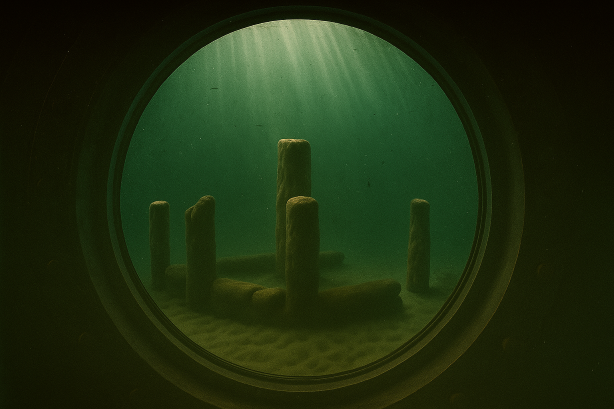

Silent Circle Survey Debrief
Held at the Park Palace Hotel, Traverse City, Michigan
Date: October 28, 2025
Recorded by: Klara Nilsen, Senior Recorder
1. Call to Order
Meeting convened at 18:30 hours by Presiding Concordant Alistar Corvus. Present were:
Alistar Corvus (Presiding Concordant)
Gerald “Charts” Whitcomb (Senior Keeper of Hydrographic Records)
Eleanor Price (Field Documentation Officer)
Edwin Barlow (Ceremonial Logistics Officer)
Klara Nilsen (Recorder)
Guests: None. GLRC observers were not invited to this session.
2. Opening Remarks
Corvus commended the team for “courage under conditions that defied both forecast and precedent.” He reiterated the need for discretion and composure in all external communications pending the preparation of the official narrative.
He further noted: “The lake is never unobserved, but it seldom volunteers. The Order has now been permitted something unusual — perhaps too unusual.”
Barlow recorded this statement verbatim and underlined it twice.
3. Operational Review
Nilsen summarized field operations chronologically. All analog data and ledgers were confirmed dry and intact. Electrical data suffered minor corruption during the six-second outage.
Barlow suggested adding a ceremonial classification for the storm event. Corvus declined, stating the phenomenon was “under investigation but not yet symbolic.”
4. Discussion: Nature of the Storm
Price initiated discussion by stating plainly, “That storm wasn’t weather. It had timing.”
Her assertion prompted extended debate:
Barlow: Proposed the storm was “responsive,” noting barometric readings changed the moment the submersible reached target depth.
Whitcomb: Described the sensation within the sub as “not pressure but presence,” clarifying, “It didn’t move through us; it recognized us.”
Corvus: Requested that such phrasing be “translated into measurable terms before entered into record.”
Price: Replied, “Measurable or not, it happened exactly when the Concord touched the stones, and it ended exactly when she surfaced. If that’s coincidence, it’s a polite one.”
Nilsen: Added that no known meteorological model accounts for that rate of formation or dissipation.
Barlow: Suggested a divine alignment, “the lake reclaiming a rhythm.”
Corvus: Corrected, “Perhaps resonance, not reclamation.”
Following twelve minutes of exchange, consensus was reached that while the storm’s exact cause remains unverified, its coincidence with subaqueous contact warrants further inquiry.
5. The Six Seconds
Discussion returned to the synchronized power loss.
Whitcomb confirmed that both analog and digital systems ceased simultaneously despite separate power sources.
Corvus suggested cataloging the gap as “Phase Interruption – Temporal Concordance.”
Price remarked, “Or just call it what it was — silence.”
Barlow proposed a moment of silence to “honor the silence,” which Corvus rejected as “performative.”
6. Statement of Senior Keeper Whitcomb
At 19:08, Whitcomb rose and spoke without notes.
“During descent, I felt something pass through the hull. It wasn’t sound or current — it was recognition. The lake knew we were there. When the systems died, I didn’t feel loss of control. I felt included. I can’t chart that. It doesn’t fit on paper. But if you’ve ever been listened to by water, you know it isn’t imagination.”
The room was silent.
Barlow murmured agreement. Price stared at the floor. Corvus offered no reply, only recorded the time of Whitcomb’s statement as 19:09 and marked it in the ledger with the annotation “subjective anomaly.”
7. Points of Divergence
Corvus emphasized the need for restraint in public interpretation.
Price insisted that “understating the storm would be dishonest.”
Barlow motioned for a temporary moratorium on public commentary until internal consensus could be achieved. Motion carried unanimously.
Whitcomb abstained, stating, “Consensus doesn’t apply to what isn’t done speaking yet.”
8. Closing Remarks
Corvus thanked the team for “their composure in extraordinary conditions.” He concluded:
“We are not here to assign meaning, only to record the moment meaning arrived.”
Meeting adjourned at 20:12 hours.
Recorder’s Addendum
In the minutes, the event is an anomaly. In the room, it felt like recognition — brief, enormous, and gone. None of us said the word supernatural, but the air behaved as if it had heard it anyway.
Archivist’s Note (K. Nilsen)
This log was not included in the official minutes but was transferred to the Rawley Point Ledger Archive under “Supplemental Testimony – Field Documentation.”
The final line coincides precisely with a minor electrical disturbance recorded across multiple GLRC monitoring stations at 23:48:17 CST. Cause undetermined.
Private Audio Log – Eleanor Price
(Recorded 23:48 hours, Park Palace Hotel, Traverse City)
File name: fieldnote_postsurvey_price_25oct25.wav
Transcription prepared by Recorder Nilsen (archival copy withheld from public ledger)
[00:00:02]
Okay. It’s just me, the recorder, and what’s left of the minibar coffee. I’m supposed to be asleep. Everyone else is pretending to be. But if I don’t say this out loud, it’s going to start editing itself in my head, and by morning it’ll be safe, which means useless.
[00:00:20]
Today was not a normal storm. I’ve seen squalls — real, ugly, honest weather. This wasn’t that. It was surgical. Precise. It waited.
When the sub went down, the lake was flat. Then the systems died — all of them — and six seconds later, everything woke up angry. It didn’t build like a storm; it arrived. Like something was listening for the right cue.
[00:00:46]
And here’s the part where I sound like one of Barlow’s pamphlets, but I swear it felt aware. The wind didn’t just hit; it moved around us, like it was circling. The thunder came late, like punctuation.
Charts says it “recognized us.”
Corvus called it “resonance.”
I call it timing.
And timing is intention.
[00:01:08]
I tried to film some of it. My camera refused to focus. The footage is just gray static and two seconds of light bending where it shouldn’t. I thought it was lens flare, but the angles don’t work. It’s like the lake blinked.
[00:01:26]
Afterward, when the water settled, the air smelled different. Not ozone — something colder, mineral, like the inside of a cave. Everyone kept talking about calibration. I just stood there trying to feel normal again.
The part that won’t leave me alone is this: when the Little Concord resurfaced, the waves stopped instantly. Not gradually. Like someone flipping a switch.
I’ve seen weather settle. It doesn’t do that.
[00:01:52]
I don’t believe in curses, or omens, or underwater gods, or whatever poetic nonsense Corvus will wrap this in by next week. But I do believe in energy.
And today felt like energy with an opinion.
[00:02:05]
Barlow called it “responsive.” That’s the word he used. “The lake responded.”
He’s wrong. It initiated.
It started it.
[00:02:14]
[Short pause — faint sound of wind against the window.]
When you grow up around these lakes, you learn they’re never quiet — even when they look it. There’s always sound in them: the deep stillness, the creak of ice, the undertow muttering in dialects no one translates anymore.
But tonight, it’s dead silent. Not empty — held. Like it’s waiting for the next word.
[00:02:42]
If you’re listening to this later — Corvus, Klara, whoever’s doing the archiving — please don’t scrub it down to “meteorological anomaly.” Just… leave a margin for mystery. The lake earned it.
And if anyone ever asks me what happened, I’ll say: the weather noticed us.
[00:03:06]
[End of recording. Faint static, then a single crack of thunder in the distance before tape ends.]