
Vessel Spotlight: The Concord, A Ranger R-43 With History in Her Wake
By Mark Ellingson, Midwest Marine Monthly
"The lake respects redundancy."
Captain Rowan Thorne
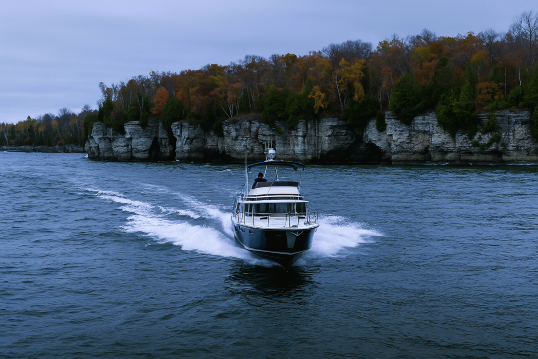
On a cold November morning at Manitowoc Marina, The Concord sits at her slip like a boat waiting for an assignment. The Ranger R-43 Command Bridge is a familiar sight on the Great Lakes, a favorite among long-range cruisers and Loop veterans, but this one carries itself differently. Its lines are tidy. Its brass shines a little more. Its decks feel walked, not posed.
The vessel belongs to the Order of the Great Fifth Sea, a shoreline research collective that mixes field observation with a kind of timeless seamanship. Most groups of this size would run a skiff or a modest outboard. The Order chose a fully outfitted R-43 and have spent the last several seasons proving why.
Captain Rowan Thorne is at the helm when I arrive, dressed in vintage marine-wear that looks like it is inherited rather than purchased. He greets me with a nod, adjusts the trim tabs with experienced flicks, and checks the analog compass before touching the Garmin screens.
“Redundancy,” he says, noticing my look. “The lake respects redundancy.”
A Boat That Has Been Places
Though the Order keeps to themselves as a private society local mariners know The Concord by reputation. She has run from Manitowoc to Ludington in angry crosswinds. She has made late-season crossings to Frankfort when most Great Lakes cruisers are already winterized. She has completed slow shoreline drifts between Two Rivers and Algoma to document sand migration. In summer, she has ranged as far south as Chicago for archival mapping expeditions and as far north as the Straits, following old freight routes for historical chart reconstruction.
"These are not epic voyages. Just steady ones."
Captain Rowan Thorne
Range matters for that kind of work. Fully fueled, the R-43’s 300-gallon diesel capacity translates to a comfortable 250 to 300 nautical mile range with conservative throttle and IPS efficiency. Rowan and his crew keep an even gentler pace, which buys them a margin most Lake Michigan captains envy.
Under the Hood: Maintenance as Ritual
Down in the engine room, the twin Volvo Penta D6 IPS drives look as if they have been curated by museum conservators. Every seasonal service interval is not just followed but documented in writing that borders on calligraphy. Fuel filters are dated, sealed, and stacked like medical supplies. There is no grime. No forgotten rags. No mystery drips.
“Order’s rule,” Rowan says. “If the engines are clean, the mind is clean.”
The D6s deliver their usual crisp performance when we head out, quick throttle response, subdued vibration, and that signature IPS obedience when the captain nudges the joystick. Even in early-winter chop, the boat feels planted, confident, and uninterested in drama.
Eleanor Price, wearing a bright Pokémon shirt beneath her fleece, perches near the aft enclosure with a hybrid sensor bristling with wires and hand-labeled components. “Don’t worry,” she tells me as she tunes a gain dial. “Nothing here is radioactive. Probably.”
Layouts and Long Hours
The R-43’s salon is warm in a way that only diesel heat on a cold lake can be. Big windows. Solid cabinetry. Real space to breathe. The Order’s crew has adapted it for fieldwork without altering its core comforts. A 1958 Mariner’s Almanac sits between a modern Great Lakes weather atlas and a stack of shoreline drift studies. A hand-crank coffee grinder rattles to life each morning, echoing through the cabin like an old diesel warming up. The heavy oak clipboard from a long-defunct Two Rivers foundry sits on the table, its patina deepened by hundreds of mission logs.
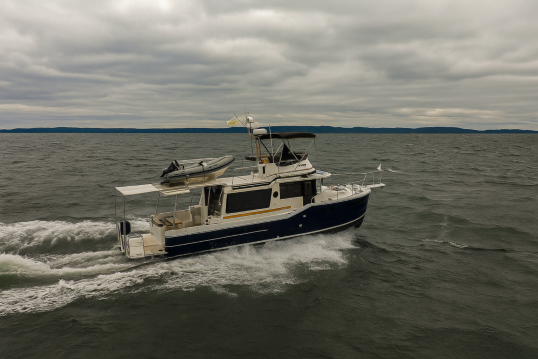
The flybridge enclosure is tight and warm, which means the boat can run in conditions most cruisers avoid. Standing behind Rowan as he guides the boat deeper into chop, I see why the Order picked this hull. High freeboard. Predictable tracking. A bow that does not ask for attention. Everything about the design supports long hours on the water.
"Time is the real endurance test."
Eleanor Price
“We are out here for six hours. Sometimes twelve. Sometimes two days,” Eleanor says. “This boat forgives the long days.”
Performance Underway: Honest, Steady, Unpretentious
Lake Michigan rarely cooperates with editorial schedules, but today it gives us what boating writers secretly prefer, truth serum. Short, steep chop. Northerly chill. That heavy-silver light that flattens distance and tests a hull’s manners.
The R-43 behaves exactly the way Ranger owners hope it will. She embraces the chop rather than fighting it. There is a confidence in the hull’s movement. The kind that gets earned through hours, not marketing.
Fuel burn at cruise is consistent with what Ranger advertises, but Rowan often runs the vessel a touch under her most efficient speed, trading time for safety and sensory clarity. “The lake broadcasts more signals at eighteen knots than at twenty-four,” he says. “Easier to hear what the water is doing.”
He shows me the laminated 1967 temperature chart taped behind the fuse panel door. Six locations are circled in red grease pencil, their purpose unspoken but respected.
“That is our reminder,” Rowan says, “that history is still useful.”
I do not doubt him.
The Warmth Beneath the Odd Stories
You can misinterpret the vintage storm glass, the signal lamp, the taffrail log, the antique clipboard, the Pokémon shirt, the hybrid sensor cobbled from multiple decades of parts. They sound peculiar on paper.
But on board, none of it feels eccentric. It all feels earned.
Every odd tool is paired with a modern one. Every analog tradition is paired with hard data. Every moment of humor is paired with seamless seamanship. Rowan trims the boat with a kind of quiet, practiced grace. Eleanor logs data with pencil scratches that sound steady as a metronome. The boat itself feels like a third crewmember, not elegant, not flashy, but deeply competent.
Final Impressions: A Ranger R-43 That Works as Hard as Its Crew
Back at the dock, the wind sharpens and the sky fades toward the early dusk of a Wisconsin winter. Rowan shuts down the D6s with the respectful calm of someone closing a book they have read too many times to count. Eleanor tucks her instrument into its case, a vintage Thermos lunchbox repurposed with surprising tact.
I ask Rowan what keeps him loyal to this boat.
“Consistency,” he says. “The lake changes mood, but this hull does not. You treat her right, she brings you home.”
"The lake changes mood, but this hull does not."
Captain Rowan Thorne
Eleanor, still in her Pokémon shirt, adds as she packs away her sensor, “And she has room for all our weird stuff. That helps.”
Standing on the dock watching The Concord settle into her lines, I realize the boat is warm in a way that transcends teak, diesel heat, and good upholstery. She is warm because she is lived in. Because she is trusted. Because she has carried people across good water and bad, and they have cared for her in return.
If every boat reflects its crew, then The Concord is exactly what she should be, a patient, capable, seasoned Great Lakes vessel tended by people who understand that Lake Michigan does not reward flash. It rewards attention, humility, and work.
And on this boat, there is plenty of all three.