
The Solstice Walk and Related Developments
(Commonly Referred to as “The Alistair Corvus Cold Exposure Event,” with No Further Clarification)
It was Presiding Keeper Alistar Corvus who stepped forward.
Not recklessly. Not ceremonially. Simply to confirm what the group already believed: that the shoreline ice, while imperfect, was sufficient.
The lake disagreed.
The ice yielded with professional restraint. One leg went through, then the other, slowly enough that dignity had time to respond before gravity did. Alistar did not fall. He arrived several inches lower than planned, arms slightly out, posture impeccable.
“I am,” he said calmly, “in the lake.”
That sentence detonated the Order.
Response Vector One: Immediate Aid
A rope appeared in seconds. Eleanor and Klara moved without speaking, anchoring footing, managing angles, voices low and precise. Extraction began smoothly, efficiently, like they had trained for this exact thing and deeply hoped they never would.
Response Vector Two: Unlicensed Heroics
Thomas Ashford, meanwhile, experienced a different interpretation of urgency.
“We need to prevent hypothermia,” he announced, already unzipping his coat.
“Skin-to-skin is the fastest way to stabilize core temperature.”
No one had authorized this plan. No one stopped it fast enough.
Hat off. Scarf off. Gloves discarded with purpose.
Alistar, still half-supported by rope and colleagues, looked down at him.
“Thomas,” he said evenly, “I am not dying.”
“That’s how hypothermia gets you,” Thomas replied, wrestling with a stubborn zipper. “You think you’re fine.”
“I am wet,” Alistar said. “Not desperate.”
“This isn’t about comfort,” Thomas insisted. “This is science.”
“Pause,” Eleanor said, sharply now. “We are pausing the science.”
Thomas froze mid-disrobing, jacket half off, deeply offended by the implication that he might be inappropriate rather than prepared.
Response Vector Three: Equipment Escalation
At that exact moment, Silas was dispatched inland with a single directive.
“Chapter House,” Klara said. “Now. Get the space blanket.”
Silas nodded once and ran.
Not a jog. A full, boots-slipping, arms-pumping sprint through snow and trees toward Rawley Point Chapter House like a courier fleeing a frozen battlefield.
Response Vector Four: Administrative Catastrophe
While all of this unfolded, Gerald “Charts” Whitcombe had stepped aside, crouched over a portable marine radio.
“This is nearing a distress threshold,” he muttered, adjusting the antenna.
Alistar, from the lake, said, “Charts, do not—”
Too late.
Charts pressed the button.
What went out was calm, clipped, and devastatingly competent.
“Unplanned ice failure. Presiding Keeper partially submerged. Cold exposure risk. Shore party responding.”
Channel sixteen.
The response came back immediately.
“Station acknowledged. Coast Guard standing by.”
Charts looked up, satisfied. Then looked back down.
By the time Alistar was fully extracted, wrapped in rope and dignity, Thomas had been verbally restrained, Eleanor and Clara had established thermal control, and Silas was already on his return sprint.
“Charts,” Clara said, “cancel the call.”
Charts shook the radio.
Nothing.
He tapped it.
Nothing.
He opened the battery compartment.
Dead.
Dead-dead.
No flicker. No apology.
“We cannot,” Charts said quietly, “call off the Coast Guard.”
Silence.
Then sound.
Low. Distant. Mechanical.
Engines designed not to ask permission.
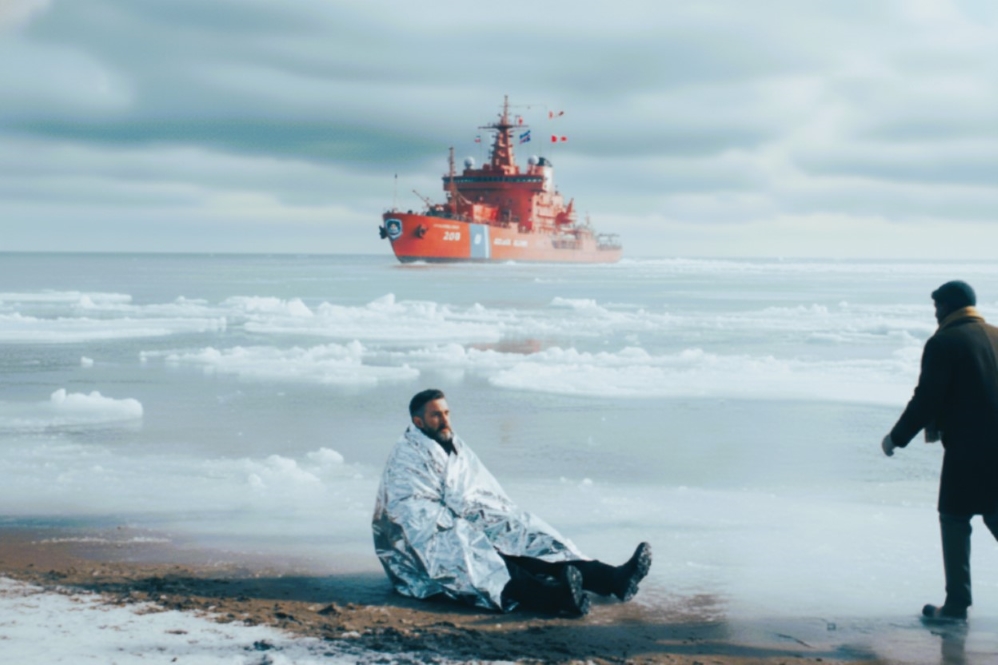
Out on Lake Michigan, through ice and grey, a Coast Guard icebreaker appeared. Large and Red. Relentless. Ice parted in front of it like paperwork being filed under Unavoidable.
Binoculars came up on deck.
Binoculars came up on shore.
Silas returned at a dead run, skidding to a stop and holding a space blanket aloft like a sacred artifact.
“I HAVE IT.”
It unfurled immediately, violently, becoming reflective chaos. Klara grabbed one corner. Eleanor another. One edge slapped Thomas in the face. He accepted this as fair.
Alistar was wrapped. Stabilized. Upright. Very cold. Very alive.
The loudspeaker crackled.
“Shore party, this is Coast Guard. Please indicate status.”
Alistar, wrapped in foil, stepped forward.
“We are,” he called in a booming voice, “no longer in immediate peril.”
A pause.
From the bridge of the cutter, Captain Jane Green stared through binoculars at the scene.
She saw:
A man wrapped like emergency leftovers
Another man half-undressed, still holding a glove
A third holding a radio like it had betrayed him
Several others gripping a space blanket as if it might escape
And absolutely no visible emergency that justified an icebreaker
She lowered the binoculars.
“Ma’am?” his first officer asked.
Green exhaled slowly.
“I have,” she said, “broken ice for 15 winters. I have pulled fishermen out of freezing water. I have responded to things that made sense only later.”
She raised the binoculars again.
“I have never,” she continued, “seen whatever this is.”
She keyed the mic.
“Please clarify.”
Alistar shouted, perfectly composed.
“We were in danger,” he said. “Then we became… organized.”
Another pause.
Green closed her eyes.
“Understood,” she said finally. “We will… stand by.”
The cutter idled. Steam rose. Somewhere, a log entry was written with visible reluctance.
After a long, quiet stretch, the icebreaker turned and withdrew, leaving the lake to resume pretending nothing had happened.
Aftermath (Filed, Revised, Whispered)
The event is logged as Cold Exposure with External Maritime Response
Thomas Ashford is never mocked, but is now gently redirected during emergencies
Charts Whitcombe is required to check batteries before touching radios
Space blankets are now staged in three locations and one coat pocket
Captain Green requests, annually, “confirmation that the Order is not holding events on unstable ice”
The Solstice Walk will continue every year.
Slightly inland.
With better batteries.
And absolutely no mention of skin-to-skin unless explicitly invited.