
The Ryan Smith Field Report (Archived Without Objection)
From time to time, the Order is required to interact with external systems whose logic operates independently of shoreline, season, or circumstance. This document records one such interaction.
The following field report was authored by a federal compliance officer assigned to review an external funding pathway associated with an Order research initiative. During the course of that pathway, the initiative was internally funded and proceeded without interruption. The review was therefore rendered unnecessary.
The review was not canceled.
What follows is the auditor’s own account of the visit, preserved in full and without comment. It is entered into the log for the sake of completeness, institutional memory, and because it seemed improper to discard a document produced with such care.
Readers are reminded that the Order does not solicit audits.
It does, however, keep records of those that arrive.
Audit Field Report
Ryan Smith
Senior Compliance Officer, US Office of Management and
Inter-Agency Review and Compliance Division
Regarding: Observational Review of Funding Process and Archival Practice
Associated Initiative: Post-Submergence Decomposition of Arboreal Cargo in Cold Freshwater Environments:
A Longitudinal Observation of the Rouse Simmons Site
This assignment should not have taken place.
By the time I arrived, the external funding pathway under review had already been rendered irrelevant. The proposed research initiative had been internally financed. No compliance risk remained. No corrective authority could be exercised. In ordinary circumstances, the visit would have been canceled and the file quietly closed with a brief notation indicating administrative redundancy.
It was not canceled.
Travel authorization had been issued. Lodging arranged. Time accounted for. In my experience, once an audit exists on paper, the system prefers completion to reconsideration. Cancellation introduces questions. Completion produces closure. Closure is favored.
So I went.
The research initiative under review concerns the remains of the Rouse Simmons, a schooner that sank in Lake Michigan in November of 1912 while transporting a seasonal cargo of Christmas trees. The vessel was caught in a severe storm and lost with most hands. Over time, the Rouse Simmons entered regional memory not primarily as a commercial loss, but as a cultural one. It is frequently referred to as the “Christmas Tree Ship,” and has become a fixture of Great Lakes lore, commemorated annually and treated with a degree of sentimental reverence that exceeds its material scale.
What is less commonly discussed is the cargo itself. The trees, preserved by cold freshwater conditions, settled on the lakebed and have remained there in various states of decomposition for more than a century. The proposed study seeks to observe that process as it continues, without intervention, and to document its ecological effects with particular attention to localized benthic interaction and material persistence. It is a modest project by most standards, notable primarily for its patience.
The Order of the Great Fifth Sea does not announce itself in the way most organizations do. There was no clear threshold where administration began and observation ended. I was greeted by a man who seemed unsurprised to see me and mildly apologetic that I had arrived during a moment of transition, though I could not identify what that transition was. This was George E. Bjork.
George had printed my itinerary. I had not provided it to him. He explained, at some length, how he inferred it and apologized for a formatting inconsistency on the second page.
This was my first indication that the assignment would not proceed as expected.
George E. Bjork occupies what he describes as an administrative role, though this description is insufficient. He does not simply manage process. He appears to live within it. His manner is careful, earnest, and unfailingly explanatory. When he answers a question, he does not merely respond. He contextualizes. He clarifies. He anticipates misunderstanding and attempts to head it off gently, with documentation.
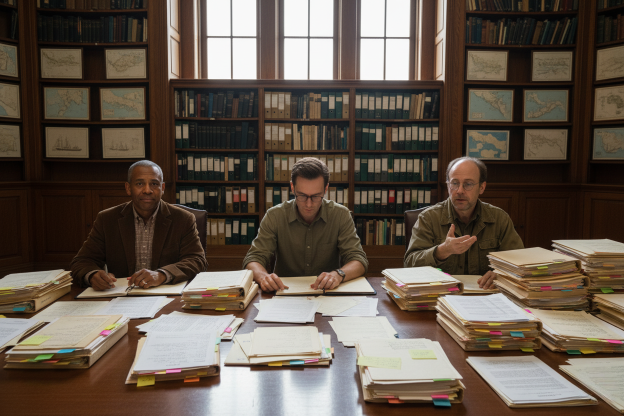
He showed me the grant file. Then he showed me the internal memo explaining the grant file. Then he showed me the correspondence justifying the existence of the memo. At no point did I feel he was attempting to overwhelm or obscure. On the contrary, I sensed a genuine concern that I might not fully appreciate the procedural integrity of the effort unless everything was made visible.
When I remarked that the project no longer required external funding, George agreed immediately. There was no defensiveness in his response.
“Yes,” he said. “But the process still concluded.”
He handed me a document titled Resolution. It did not celebrate the outcome. It documented it. George appears to believe that processes, like people, deserve a proper ending. The success or failure of the outcome seemed secondary to the fact that the procedural arc had been completed.
At several points during our discussion, I was offered tea. The tea was labeled. The label included the type, the date of acquisition, and a handwritten note indicating that it was “still good.” This was not part of the audit. It felt relevant anyway.
Silas, the scientific lead on the initiative, occupied a markedly different posture. Where George’s workspace was orderly, dense, and cross-referenced, Silas’s was sparse. A few working documents. A notebook. Data summaries that appeared provisional rather than curated. Silas spoke quietly and precisely. He did not attempt to persuade. He explained.
“The trees are there,” he said, gesturing vaguely toward the lake. “They’ve been there for a long time. They’re changing slowly.”
He did not emphasize the shipwreck itself until I did. The event, for him, was secondary to what followed. The study was not framed as an act of discovery, but as an obligation to observe something already occurring.
When I asked why external funding had been pursued despite internal capacity, Silas paused before answering.
“Because,” he said, “that’s how work becomes legible.”
Silas does not appear to resent bureaucracy, nor does he embrace it. He treats it as a translation mechanism. Necessary. Imperfect. Not the work itself, but a toll required for the work to travel.
The funding attempt, reconstructed through George’s records, was extensive. The proposal did not fail. It adapted repeatedly to shifting criteria that seemed to change without moving. Language was softened, reframed, then softened again. Terms like “decomposition” were debated at length. Christmas trees were variously described as organic material, cultural artifact, and legacy seasonal infrastructure.
As the proposal became more palatable to external frameworks, Silas’s scientific clarifications became sharper and more exacting. This is not unusual. What is unusual is that every version of this process was retained.
George believes forgetting is a form of loss.
The Order’s archival practices exceed external requirements by a wide margin. Nothing appeared to be kept out of anxiety or fear. Materials were not retained “just in case.” They were retained because they existed. When I asked why inactive correspondence was preserved, George answered simply, “So we remember what happened.”
Silas did not contradict him.
I am trained to identify inefficiencies, and there are many here. None of them appear accidental. The Order does not optimize for speed. It optimizes for continuity. Its work does not escalate. It accumulates.
This is not how most institutions operate. It may be how this one survives.
The audit produced no findings. The project is funded. The records are complete. The individuals involved understand precisely what they are doing, even when it does not align with external logic.
The assignment is complete.
There is, however, something quietly disarming about an organization that treats documentation not as defense, but as a form of care. I did not come here for the lake. I am not even sure I came here for the audit. I leave with a professional admiration that I cannot formally recommend, but do not regret.
Filed accordingly.