
The Order of the Great Fifth Sea
Year in Review — 2025
Entered into the Aligned Ledger
The Order of the Great Fifth Sea records 2025 as a year of sustained field practice, disciplined inquiry, and measured outward engagement. The following reflects the year’s principal activities as they occurred, with references preserved for public record.
Establishment of the Public-Facing Archive
Early in 2025, after extended internal debate, the Order authorized the creation of a public-facing website.
The decision followed prolonged discussion regarding visibility, misinterpretation, and the risks inherent in translating shoreline practice into readable form. Silence was considered a valid alternative and ultimately declined.
The site was established as an archive rather than a platform, intended for formal notices, field records, and continuity documents. Publication clarified recordkeeping discipline without altering internal cadence.
↳ Archive reference:
https://fifthsea.org/blog/
The Silent Circle Survey
The Silent Circle Survey constituted the Order’s most significant field activity of the year.
Conducted in Grand Traverse Bay, the survey combined shoreline traversal, near-shore vessel work, and coordinated observation. The research launch The Concord served as the primary platform.
During the survey window, a brief, simultaneous systems interruption was recorded across vessels and instruments. Observers logged divergent experiences without forced synthesis. A sudden storm curtailed the window, compressing time and altering return conditions. The survey concluded without closure, preserving unresolved observations intact.
↳ Field log:
https://www.fifthsea.org/blog/post-57/
Shipwreck Congress Activities
Throughout the summer, the Order undertook preparatory work related to the Shipwreck Congress.
Activities included the assembly of regional wreck records, comparative timelines, and methodological framing for discussion of submerged heritage. Wrecks were treated as dynamic shoreline participants shaped by sediment, current, and seasonal exposure.
This work established common ground for broader engagement without spectacle.
↳ Congress preparatory record:
https://fifthsea.org/blog/2025/08/24/
Return to Service: The Concord
The research launch The Concord returned to active service following maintenance and readiness checks.
Its reactivation restored near-shore operational capacity and supported coordinated field activity during the latter half of the year. The vessel continued to function as a shared observational platform rather than a command asset.
↳ Vessel log:
https://fifthsea.org/blog/
Instrument Adoption: Detectron Model 7-T
The Detectron Model 7-T was formally inducted into field use.
Selected for durability and interpretive restraint, the instrument was employed in littoral survey work to encourage attention rather than certainty. Its adoption reinforced the Order’s preference for tools that slow observation and sharpen judgment.
↳ Instrument record:
https://www.fifthsea.org/blog/post-33/
Visiting Scholar Affiliation: Dr. Basil Cartwright
Dr. Basil Cartwright, an Egyptologist affiliated with the Royal Society of Egyptian Antiquities, joined under a temporary affiliation.
His participation included access to selected archives and limited field presence. Comparative discussions addressed riverine civilizations, funerary landscapes, and symbolic systems of orientation. A scheduled lecture examined parallels between ancient cartographic language and shoreline practice.
The affiliation concluded as defined.
↳ Affiliation notice:
https://www.fifthsea.org/blog/post-35/
Internal Deliberations and Recorded Minutes
Formal deliberations were convened during the year to address field priorities, archival standards, and external engagement.
Minutes were recorded with emphasis on accuracy over efficiency. Clarifications were issued where needed. Disagreements were preserved rather than resolved prematurely.
↳ Deliberation record:
https://fifthsea.org/blog/
Visual Documentation and Member Record
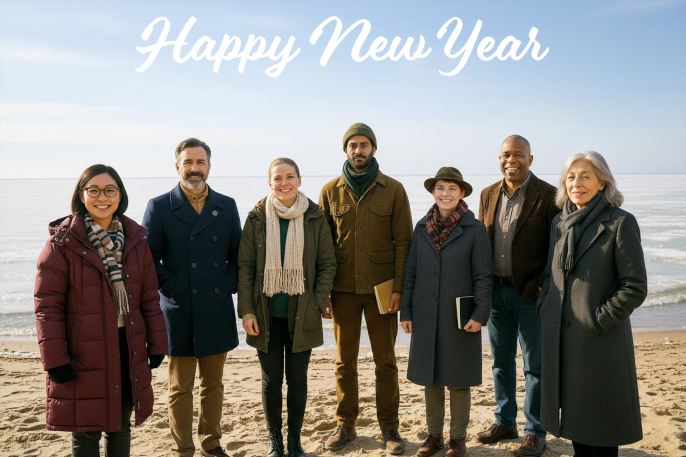
The Order expanded its visual and personnel record through curated documentation of members, vessels, and working spaces.
This activity emphasized continuity and presence over portraiture, adding context to field logs and reinforcing the human scale of the work.
↳ Member and vessel features:
https://fifthsea.org/blog/
Public Recognition
During the winter survey season, Order field activity received coverage in Fresh Coast Magazine, acknowledging ongoing shoreline work and observational method.
The recognition was logged for recordkeeping purposes. No formal response was issued.
↳ Recognition notice:
https://fifthsea.org/blog/
Seasonal Observances
The Annual Winter Solstice Potluck and Shore Walk proceeded as a Continuity Observance.
Members gathered, walked the shoreline, and concluded without embellishment. Environmental
Administrative Review
The year concluded with an external administrative review conducted by the Inter-Agency Review and Compliance Division.
Findings were documented. Clarifications were provided. Operations continued without material change.
Summary
2025 marked a subtle shift in posture.
The Order remained what it had been, but allowed itself to be seen. Field practice deepened. Instruments returned to use. Records thickened. Questions stayed open.
The shoreline moved.
The memory held.
Custodes Litoris. Memoria Maris.
Scholarly Contributions and Formal Articles
In parallel with field activity and public documentation, the Order produced several formal written works during 2025 intended for academic, archival, and interdisciplinary readership.
These articles reflect the Order’s commitment to precision, restraint, and regional specificity, and were developed as durable references rather than commentary.
Meteotsunamis in the Great Lakes: Observations, Terminology, and Cultural Misclassification
A formal article examining meteotsunami phenomena within the Great Lakes system, with particular attention to Lake Michigan.
The work addresses meteorological causation, historical mislabeling, and the persistent tendency to import oceanic terminology into freshwater systems. Emphasis is placed on observational rigor, regional accuracy, and the importance of aligning language with physical reality.
↳ Article record:
https://fifthsea.org/blog/
The Misplaced Apex Predator: A Speculative Inquiry into Sharks in the Great Lakes
An interdisciplinary paper exploring the persistent cultural myth of sharks in the Great Lakes.
Rather than treating the subject as debunking exercise alone, the article examines why such myths endure, how narrative fills ecological silence, and what these stories reveal about collective imagination, fear, and absence in freshwater environments.
↳ Article record:
https://www.fifthsea.org/blog/post-25/
Instrumentation, Attention, and Interpretive Restraint in Littoral Survey Work
A technical-methodological article developed alongside field adoption of legacy instruments, focusing on how tool design influences observer behavior.
The work argues for the continued relevance of analog and low-automation instruments in shoreline research, particularly where ambiguity and judgment are integral to understanding change over time.
↳ Article record:
https://www.fifthsea.org/blog/post-33/
Notes on Riverine Memory, Funerary Landscapes, and the Administrative Afterlife of Place
Produced in conjunction with the temporary affiliation of Dr. Basil Cartwright, this article draws comparative parallels between ancient river civilizations and Great Lakes shoreline practice.
Topics include cyclical flooding, symbolic orientation, record permanence, and how societies document what they know will be lost.
↳ Article record:
https://www.fifthsea.org/blog/post-35/