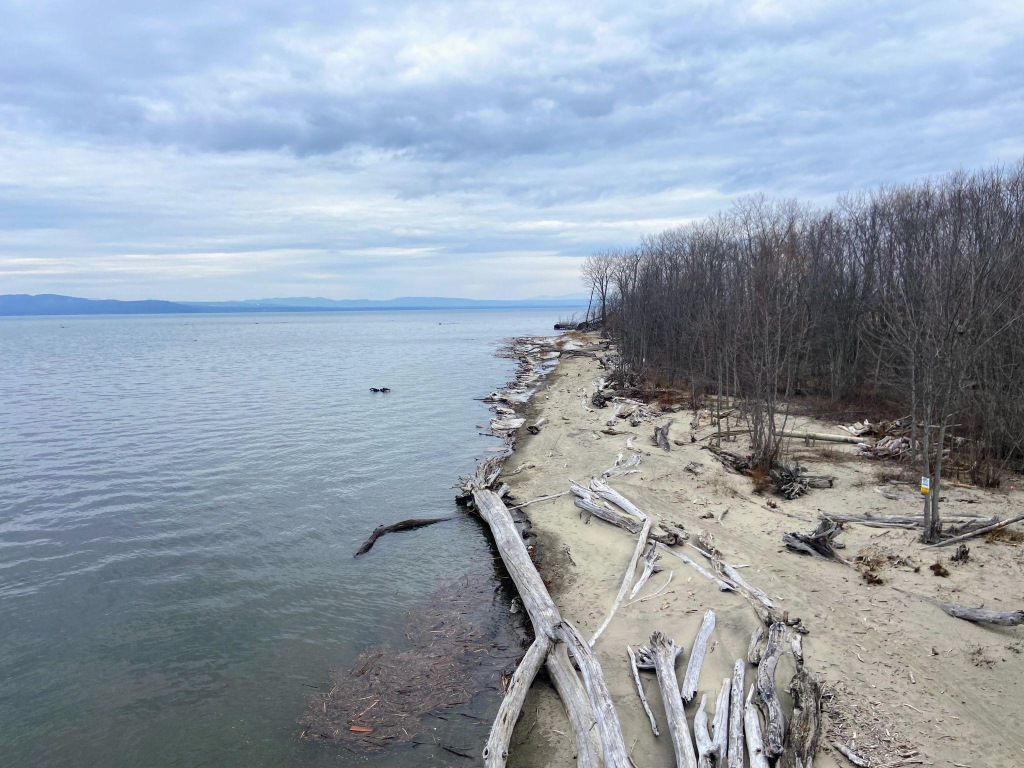

A Lake That Was Briefly Great
Submitted to the Order by Dr. Selene Armitage
Probationary Fellow, Hydrographic Studies
It seems fitting that my first submission to the Order concerns a classification error.
Not a cartographic blunder, nor a misplotted sounding, but a legal adjustment so precise and so temporary that it reads, in retrospect, like a footnote that escaped the margins. In March 1998, Lake Champlain was, by federal statute, defined as one of the Great Lakes. For eighteen days, it joined Lake Superior, Lake Michigan, Lake Huron, Lake Erie, and Lake Ontario in the statutory company of inland seas.
It is important to begin with the facts, because the facts are tidy.
On March 6, 1998, President Bill Clinton signed a reauthorization of the National Sea Grant College Program. The language of the bill included a clause extending the definition of “Great Lakes” to include Lake Champlain. The amendment was advanced by Senator Patrick Leahy of Vermont. Its purpose was neither romantic nor revisionist. It was fiscal.
Sea Grant funding supports research, education, and outreach related to large water bodies. Lake Champlain faced nutrient loading, algal blooms, invasive species, and watershed pressures consistent with those of the canonical five. Expanding the definition ensured eligibility. The mechanism was elegant in its simplicity. Change the definition, change the funding landscape.
The lake itself, I should note, did not rise in response. No additional cubic kilometers were summoned. No glacial resurgence occurred. The Adirondacks did not shift in deference.
Only the wording changed.
The reaction was immediate once the clause attracted notice. Representatives from the traditional Great Lakes states expressed concern. Arithmetic was introduced with admirable seriousness.
Lake Champlain measures approximately 435 square miles in surface area. Lake Ontario exceeds that by more than an order of magnitude. Lake Erie alone could contain nearly twenty Champlains by volume. The concern, publicly framed in terms of funding formulas and precedent, also contained a quieter dimension: identity.
The Great Lakes are not merely hydrological basins. They are industrial corridors, storm-battered coasts, maritime corridors, and cultural anchors. Their scale has shaped economies and psyches alike. To append a sixth, smaller body by legislative adjustment risked unsettling a system long treated as both geographic and symbolic.
On March 24, Congress amended the language. The specific inclusion of Lake Champlain was removed. The funding pathways, however, remained secured. Lake Champlain Sea Grant continued, and continues, to operate.
The adjective receded. The consequence persisted.
From a hydrographic standpoint, the episode invites reflection on the instability of categories.
Lake Champlain shares glacial parentage with the inland seas. In the wake of the last Ice Age, it formed part of the Champlain Sea, a brackish extension of the Atlantic before isostatic rebound altered its character and rendered it freshwater. It drains northward into the St. Lawrence River, aligning it hydrologically with the Great Lakes system. Its basin supports fisheries, commercial activity, recreation, and sustained scientific inquiry.
What distinguishes it, then, is not origin, nor ecological function, but magnitude.
Magnitude has always held persuasive power. The fetch of Lake Superior produces storms of a scale that command respect. The interconnected volume of Lake Michigan and Lake Huron shapes climate and commerce. Lake Champlain, by comparison, is narrower, more intimate, bordered closely by mountains that press in rather than recede.
Yet intimacy is not triviality. Smaller systems can exhibit greater sensitivity to disturbance. Nutrient inputs manifest more rapidly. Shoreline development leaves more visible marks. In some respects, a modest basin demands closer attention, not less.
There is, inevitably, a temptation within the Order to ask whether we missed an opportunity in 1998. Should we have convened an emergency council? Drafted a provisional charter? Considered the alarming possibility of rebranding as the Order of the Great Sixth Sea?
I suspect not.
The elegance of the Fifth lies precisely in its refusal to expand for fashion. Five is a boundary with history. It implies containment. It suggests a closed system with internal coherence. A sixth would require not only a new numeral but a new narrative.
The legislative experiment of 1998 demonstrated how easily definitions may be adjusted and how quickly they may be corrected. It also demonstrated that consequence does not always align with classification. Lake Champlain did not become physically greater when the statute changed, nor did it diminish when the wording was revised. What changed was access to resources and the symbolic alignment with a larger system.
For eighteen days, the federal lexicon expanded. Then it contracted. The watershed did neither.
I offer this account as record rather than novelty. It illustrates the tension between nomenclature and nature, between administrative categories and physical systems. It also, quietly, affirms why this Order remains the Fifth.
Water does not require our adjectives. It will persist under any number we assign.
Lake Champlain was Great briefly.
It remains consequential, which, from a scientific perspective, is the more demanding designation.