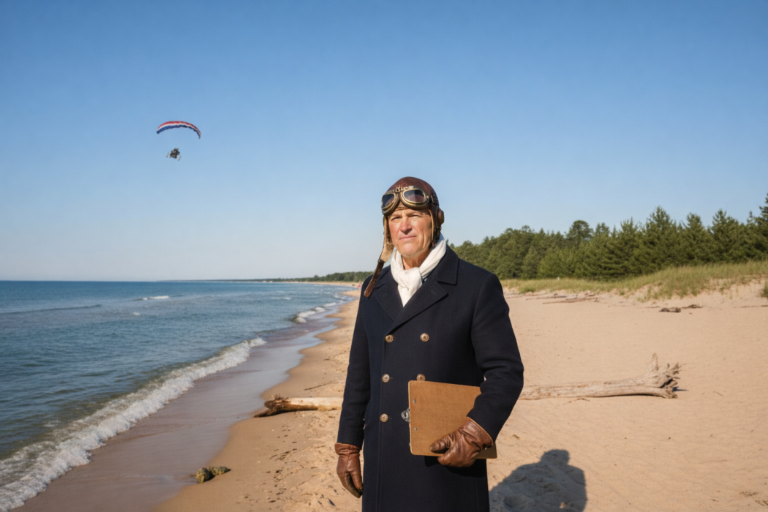

A Modest Proposal: The Powered Parachute
Minutes of the Concordant Assembly of the Order of the Great Fifth Sea
Location: Rawley Point Chapter House, Lecture Hall A
Chair: Alistar Corvus, First Keeper and Presiding Officer of the Concordant of the Fifth Sea
Recorder: Klara Voss, Keeper of the Bathymetric Ledger
1. Call to Order
The meeting convened at 19:02 hours under clear atmospheric conditions with measurable crosswind from the northeast. Windows rattled intermittently, as if registering mild objection.
Attendance confirmed. Tea present. Coffee stronger than necessary.
Klara’s marginal note: We have charts. We have ambition. We lack restraint.
2. Agenda Item IV: Aerial Littoral Observation Platform (Clarified)
Alistar opened by acknowledging that the term “aircraft” had generated “unhelpful mental imagery.” The revised proposal specifies a powered parachute for low-altitude shoreline reconnaissance.
Charts Whitcomb, Senior Keeper of Hydrographic Records, stood and unrolled a series of annotated shoreline photographs.
He described the platform as:
“A controlled drift system enabling deliberate observation at altitudes where water still reveals its secrets.”
Nora requested that “controlled drift system” be translated into plain language.
Charts replied: “It is, functionally, a flying chair.”
This clarification did not calm the room.
3. Real-World Precedent
Charts cited the documented discoveries of Brenda Z. Paull, who located numerous shipwreck sites along the Rawley Point region through slow, low-altitude powered parachute flights.
He explained that at certain sun angles, submerged timber casts a faint geometry beneath the surface. Speed disrupts detection. Altitude obscures it. Satellites lack patience.
Nora noted that patience is not typically line-itemed.
Alistar responded quietly: “It should be.”
4. Technical Rationale
Charts presented three operational advantages:
Low-Speed Survey Capability
Cruise speeds below 35 mph allow shoreline parallel drift.Low Altitude
Sub-500-foot flight permits visual discrimination of sand displacement patterns and submerged hull outlines in clear water.Minimal Infrastructure Requirement
Unlike fixed-wing aircraft, a powered parachute requires modest runway length and no complex hangar construction.
George requested confirmation that “modest” does not imply “improvised.”
Charts confirmed that the phrase “modest” refers strictly to scale.
5. Budget Considerations
Treasury Report Summary:
Recent donations have increased discretionary funds beyond projected operational baseline.
Line Item 4.3.2 amended to read:
Powered Parachute Acquisition & Training – Aspirational but Within Civilian Reality
Estimated financial envelope discussed, without precise figures entered into record at George’s insistence pending vendor consultation.
Projected expense categories:
Airframe and wing
FAA sport pilot training
Insurance and liability coverage
Seasonal storage or cooperative hangar arrangement
Safety equipment and communication systems
George advocated for early consultation with aviation insurers to avoid “a scenario in which we discover the concept of premiums after purchase.”
Klara’s marginal note: He has already drafted a compliance matrix titled “Operation Winged Prudence.”
6. Storage and Parking
Member inquiry from the south wall: “Where would it live?”
Options debated:
Boathouse Loft
Rejected due to cedar beam load tolerances and aesthetic disruption.
Carriage House West Bay
Feasible with reorganization of expedition crates and relocation of one brass anemometer of questionable necessity.
Off-Site Cooperative Hangar
Raises concerns about symbolic dilution of Order presence.
Nora asked whether we are more concerned about logistics or symbolism.
Silence followed.
7. Mission Alignment
Concern voiced regarding institutional drift.
Phrase entered into record: “Are we becoming an aviation society?”
Alistar responded:
“We are becoming more precise observers.”
Charts added:
“We study motion. Shorelines shift. Sand migrates. Water recedes and advances with seiche and seasonal fluctuation. Observation must adapt.”
Nora countered that mission creep often begins with the word “adapt.”
George requested that the term “mission creep” be excluded from official minutes.
Klara did not exclude it.
8. Public Optics and Rivalry
Discussion briefly referenced the Great Lakes Research Consortium and its growing drone fleet.
Charts stated:
“Drones are efficient. Efficiency is not the same as attention.”
Nora observed that a powered parachute may appear theatrical.
Alistar replied:
“So does tweed in a windstorm.”
Laughter recorded. Controlled.
9. Risk and Safety
Safety considerations acknowledged:
Weather variability along Lake Michigan shoreline
Training duration and certification pathway
Emergency landing protocols
George requested a subcommittee for risk modeling.
Klara’s marginal note: We are forming a committee to discuss gravity.
10. Motion
Motion introduced:
“To authorize a structured feasibility study concerning acquisition and operational integration of a powered parachute for low-altitude littoral reconnaissance in alignment with Order research priorities.”
Seconded.
George requested definition of “structured.”
Definition deferred pending white paper draft.
Vote recorded:
Affirmative majority. One abstention. No opposition.
11. Assigned Actions
Charts to produce technical white paper: Low-Altitude Littoral Observation and the Visual Ledger.
George to draft compliance roadmap including FAA certification, insurance parameters, and storage covenants.
Facilities Committee to measure Carriage House clearance to exact specification.
Communications Committee to prepare narrative emphasizing precedent, explicitly citing Brenda Z. Paull’s shoreline discoveries.
12. Closing
Meeting adjourned at 20:51 hours.
Wind reduced to near calm. Sky clear.
Klara’s final marginal entry:
We began this Order with notebooks and boots. Then boats. Now fabric wings and propellers. The shoreline moves whether we approve or not. Perhaps the only true mission creep is refusing to look from new angles.