
Aerial Observations Along the Fifth Sea
Filed by Gerald “Charts” Whitcomb, Senior Keeper of Hydrographic Records
Some months ago the Order published a short dispatch examining earlier aerial survey methods along the shoreline. That note explored the curious ingenuity of kite-borne cameras and tethered observation balloons, devices that allowed early surveyors to lift a camera above the landscape long before powered aircraft existed.
At the time the subject felt historical. Interesting for the Ledger perhaps, but not immediately practical.
Recent observations have changed that assessment.
The Historical Baseline
Kite photography represented the first reliable attempt to elevate a camera above the shoreline without constructing a tower or climbing a bluff. A large kite, steady wind, and a timed shutter could capture photographs revealing sandbars, harbor structures, and shoreline contours invisible from ground level.
Observation balloons refined the concept further by lifting the observer rather than merely the camera. From such height a surveyor could examine coastlines directly, studying river mouths, harbor geometry, and subtle changes in shoreline position.
Both systems shared a defining characteristic.
They moved slowly.
The observer drifted above the landscape rather than racing past it. That slower vantage revealed patterns otherwise hidden to the ground observer. Wave sets aligned in long arcs. Sandbars curved like pale brushstrokes beneath the surface. The lake became legible.
A Field Observation in Sheboygan
During a recent visit to Sheboygan I observed a shoreline activity that unexpectedly clarified the matter.
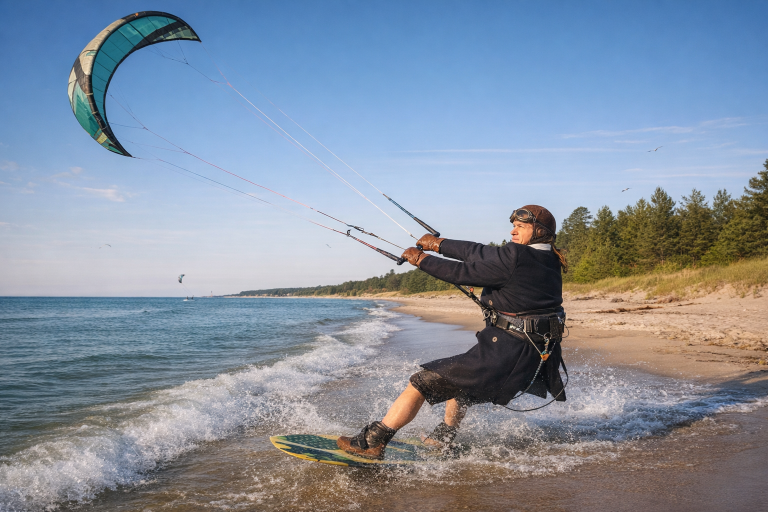
Several kiteboarders were operating just offshore near Deland Park. For those unfamiliar, kiteboarding involves standing on a narrow board while controlling a large traction kite that pulls the rider across the water.
At first the movement appears chaotic.
Then the structure reveals itself.
Each rider moves in long diagonal sweeps across the wind. The kites climb and descend in careful arcs. At certain moments the wind lifts the rider briefly above the water before settling again.
Watching from shore, the riders occupy a narrow band of air just above the lake surface. From that height they can clearly see the patterns below them. Sandbars appear as pale ridges. Darker water traces deeper channels between them.
More interesting still, every rider instinctively drifts toward the same corridors of wind shaped by the shoreline itself.
They are, in effect, tracing invisible wind maps above the lake.
The observation felt familiar. It echoed the principles used by early kite photographers more than a century ago.
Wind lifts the observer.
The observer drifts above the water.
Patterns appear.
Shipwreck Detection from Above
There is another implication worth noting.
Clear water combined with low-angle sunlight often reveals submerged objects surprisingly well from above. Many shipwrecks along the Great Lakes were first identified from aircraft photographs taken in the early twentieth century.
From altitude the surface glare softens and the lake becomes translucent. Dark geometric shapes appear against the lighter lakebed: hull outlines, scattered timbers, or the long shadow of a mast lying across sand.
Even modest elevation can make a dramatic difference. A vantage of several hundred feet allows the observer to see through the water column in ways impossible from shoreline level.
In particularly clear conditions the structure of a wreck can appear almost diagrammatic.
For those interested in maritime history, such moments are difficult to ignore.
The Modern Equivalent
This realization returns us to the matter of powered parachutes.
A powered parachute is, in many respects, the modern descendant of both kite photography and observation balloons. A ram-air canopy lifts the craft gently into the air while a small engine allows the pilot to move deliberately along the shoreline.
The aircraft travels slowly and at low altitude, precisely the conditions most favorable for observation.
From such a platform one could examine:
• seasonal sandbar migration
• sediment plumes from river mouths
• surface signatures of seiche events
• submerged structures and potential shipwreck remains
This is not speculation. The physics of water clarity and sunlight make aerial observation one of the most effective preliminary tools for locating submerged features.
The Great Lakes are full of such features.
Institutional Considerations
Naturally the proposal to acquire such a craft produced the expected discussion regarding training, storage, and the bureaucratic consequences of owning what George Bjork carefully described as “a small but technically undeniable aircraft.”
After some deliberation a simple conclusion emerged.
The Order already maintains vehicles for land travel and the Little Concord for fieldwork on the water.
An aerial observation platform completes the set.
Conclusion
It is therefore my recommendation that the Order proceed with acquiring a powered parachute for shoreline observation and exploratory survey work.
Watching the kiteboarders in Sheboygan clarified something that earlier discussions had only suggested.
Wind lifts the observer.
The observer drifts above the water.
The lake reveals its patterns.
Sometimes those patterns are sandbars.
Sometimes they are currents.
And occasionally they are the quiet geometry of a ship that has been resting beneath the Fifth Sea for a century, waiting for someone to notice.
—
Filed for the Ledger Library under: Aerial Survey Methods, Final Assessment