
Dispatches of the Fifth Sea
On the Matter of Summer Preparations at the Chapter House
By all appearances, summer arrives gradually along this stretch of Lake Michigan. The ice recedes without ceremony. The dunes soften. The air shifts from resistance to permission.
Within the Order, however, summer does not simply arrive. It is prepared for.
This distinction, while subtle to the outside observer, governs much of the Chapter House’s activity from late April through early June. The shoreline may follow its own rhythms, but the Order maintains its own calendar, one that bends toward readiness rather than reaction.
I. The Reopening of the Shore
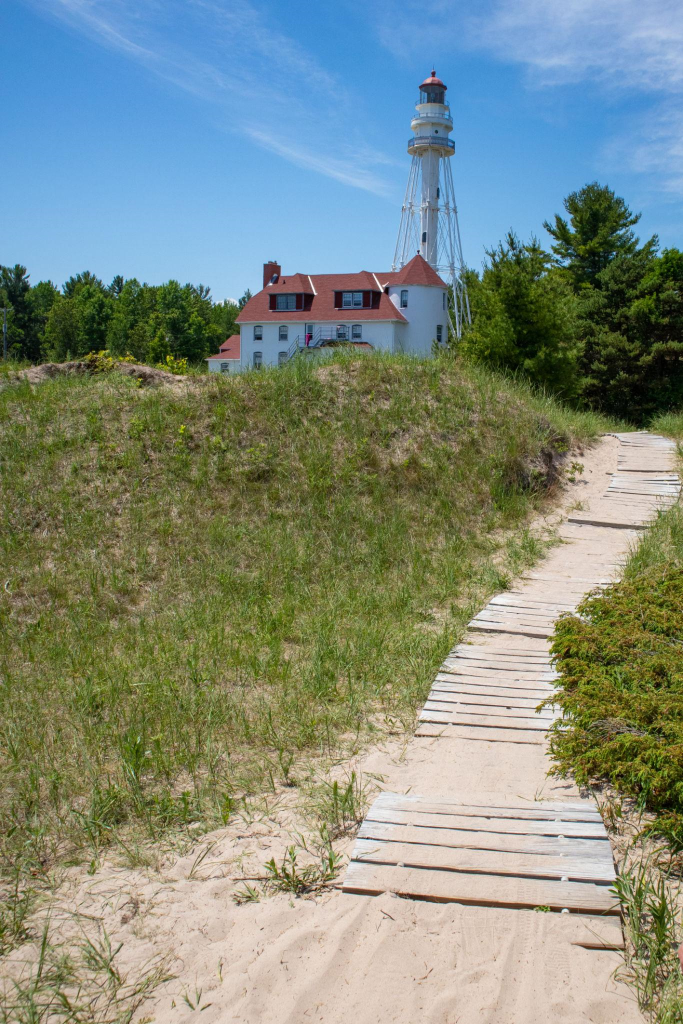
The first formal signal of seasonal transition is the reopening of the eastern approach to the Chapter House. Winter storms, as is their habit, tend to rearrange both sand and intention. Paths that existed in October are often theoretical by March.
Under the direction of Alistar Corvus, members conduct a measured survey of the littoral edge. This is not merely trail maintenance. It is an act of reacquaintance.
Driftwood is cataloged before it is moved. Notable erosion patterns are recorded. In one recent year, a section of exposed clay revealed what was later determined to be a fragment of pre-settlement shoreline layering. It remains undisturbed, marked only in the Ledger and by a small, easily missed cairn.
The shore is not reset. It is re-learned.
II. Inventory, Reconciliation, and Quiet Disagreement
Inside the Chapter House, a different kind of work unfolds.
The Workshop Annex becomes a staging ground for what is officially termed Seasonal Equipment Reconciliation. This includes inspection of hydrographic tools, maintenance of field kits, and the annual debate regarding what constitutes “necessary redundancy.”
It is here that Gerald “Charts” Whitcomb can often be found, cross-referencing prior years’ logs with a level of focus that suggests both diligence and unresolved personal philosophy.
This year’s point of contention centers on aerial observation equipment.
The proposal to incorporate a powered parachute platform, initially raised during the Spring Meeting, has not been formally approved. Nonetheless, several annotated diagrams have appeared in the margins of the Bathymetric Ledger. Their authorship has not been confirmed, though the handwriting is widely recognized.
Concerns remain. Wind variability. Launch conditions along the dunes. The question of whether “low-altitude observational drift” constitutes a method or a mood.
The matter is, as of this writing, unresolved.
III. The Concord and the Discipline of Motion
Preparation extends to the water as well.
The Concord, the Order’s primary research vessel, undergoes its seasonal recommissioning in the weeks leading up to the first full survey run. Systems are checked, then checked again, not out of distrust but out of respect for what the lake requires.
Fuel lines, navigation instruments, and hull integrity are reviewed under the supervision of senior members, with particular attention given to anomalies observed in prior seasons. Nothing is dismissed outright. Patterns, once noticed, are rarely accidental.
Early runs are deliberately uneventful.
They trace familiar routes. They confirm known depths. They reestablish the quiet understanding between vessel and water that cannot be documented but is immediately recognized when absent.
Motion, in this context, is not exploration. It is calibration.
IV. Provisions, Assignments, and the Return of Routine
By mid-May, the Order’s operational rhythm begins to stabilize.
Field assignments are distributed. Observation schedules are drafted, revised, and reluctantly agreed upon. The Boathouse returns to regular use, its lantern once again visible in the early morning haze.
Provisions shift as well.
Heavier winter stores give way to lighter fare, though the exact definition of “lighter” remains subject to internal interpretation. It is widely accepted that no official function can proceed without an excess of something, even if its necessity is later debated.
V. The Human Element
For all its structure, the Order remains, at its core, a collection of people.
There is a noticeable shift in demeanor as summer approaches. Conversations extend slightly longer. Windows remain open despite marginal temperatures. The Lecture Hall, so formal in winter, becomes a space of looser exchange.
Even the more reserved members exhibit a quiet anticipation.
There is, perhaps, an understanding that summer is not simply a season of increased activity, but of increased visibility. The lake reveals more of itself, and in doing so, invites closer scrutiny.
This invitation is not taken lightly.
VI. On Readiness
It would be inaccurate to suggest that the Order ever reaches a state of complete readiness.
There are always adjustments to be made. Instruments that behave differently than expected. Weather patterns that resist prior models. Ideas, once theoretical, that insist on being tested under less-than-ideal conditions.
And yet, by early June, a threshold is crossed.
The shore is known again. The tools are in hand. The first true surveys begin.
Summer, having been prepared for, is allowed to arrive.
Appendix A: Seasonal Readiness Checklist (Summer Cycle)
As Ratified for Internal Circulation by the Chapter House, Rawley Point
The following checklist is to be consulted, annotated, and, where necessary, quietly ignored in accordance with situational judgment. Completion does not imply readiness. Omission does not imply negligence. All items are considered conditionally essential.
I. Shoreline Reacquaintance Protocol
Confirm that all primary and secondary access paths to the eastern littoral zone are navigable, or at minimum, arguable.
Document notable driftwood formations prior to disturbance, including those later deemed “obviously temporary.”
Reestablish visual markers (cairns, stakes, or otherwise) with sufficient subtlety so as not to invite inquiry from non-members.
Verify that previously recorded erosion features either remain consistent or have evolved in ways that justify additional notation.
II. Equipment Reconciliation and Field Preparedness
Conduct full inventory of hydrographic instruments, including those believed to have been accounted for last season.
Replace or repair any component described in prior logs as “functionally acceptable.”
Confirm that all field kits contain:
At least one redundant measurement device
Writing implements that function in wind, moisture, and mild frustration
A notebook not already committed to another line of inquiry
Ensure that all cases, straps, and fastenings exhibit a level of integrity consistent with continued use rather than optimism.
III. Aerial Observation Considerations (Provisional)
Review current standing on low-altitude observational platforms, including but not limited to powered parachute systems.
Confirm that no member has independently initiated aerial deployment without at least informal acknowledgment from a second party.
Evaluate wind conditions along dune ridgelines for both suitability and interpretive ambiguity.
Record all discussions on aerial methodology in a manner that suggests deliberation rather than inevitability.
IV. Vessel Recommissioning: The Concord
Verify operational status of all primary systems, including propulsion, navigation, and observational instrumentation.
Conduct at least one controlled nearshore run with no objective beyond confirming the absence of immediate concern.
Reconcile prior season logs with current readings, noting any discrepancies that resist easy explanation.
Confirm that all crew members assigned to early runs understand that uneventful outcomes are both expected and preferred.
V. Provisions and Sustenance Alignment
Transition storage from winter-weight provisions to summer-appropriate equivalents, while retaining sufficient overlap to avoid unnecessary procurement.
Confirm that all communal supplies exceed projected need by a margin that cannot be fully justified.
Identify and quietly set aside any item likely to become the subject of prolonged discussion during active fieldwork.
VI. Assignment Distribution and Observational Coverage
Issue field assignments with clarity of purpose, even where purpose remains under active refinement.
Establish observation schedules that account for:
Dawn conditions
Midday distortion
Evening reinterpretation
Ensure that all members understand their assigned areas, as well as the acceptable boundaries for deviation.
VII. General Readiness and Conduct
Confirm that all members can locate their prior season notes without excessive delay or reinterpretation.
Reacquaint oneself with the distinction between observation and conclusion.
Maintain a posture of preparedness that does not draw unnecessary attention.
Acknowledge, without formal statement, that conditions will deviate from expectation.
Final Certification
Upon informal consensus, the Chapter House may be considered Seasonally Prepared (Qualified).
This designation does not imply control over conditions, outcomes, or interpretations thereof.
It indicates only that the Order stands in a position to observe what occurs next.