
The Silent Circle Survey
An Illustrated Address by Alistar Corvus
Presiding Concordant, Order of the Great Fifth Sea
Delivered before the Baileys Harbor Historical Society
Baileys Harbor Town Hall, Assembly Room
Baileys Harbor, Wisconsin
Transcript prepared from Alistar Corvus’s speaking copy, Klara Nilsen’s field annotations, and the Order’s official audio recording.
Editorial note by Klara Nilsen: The recording begins seven minutes before the lecture. Those seven minutes consist chiefly of folding chairs being repositioned, projector adjustment, and Mr. Whitcomb saying, “That is not the correct cable,” with increasing moral conviction.
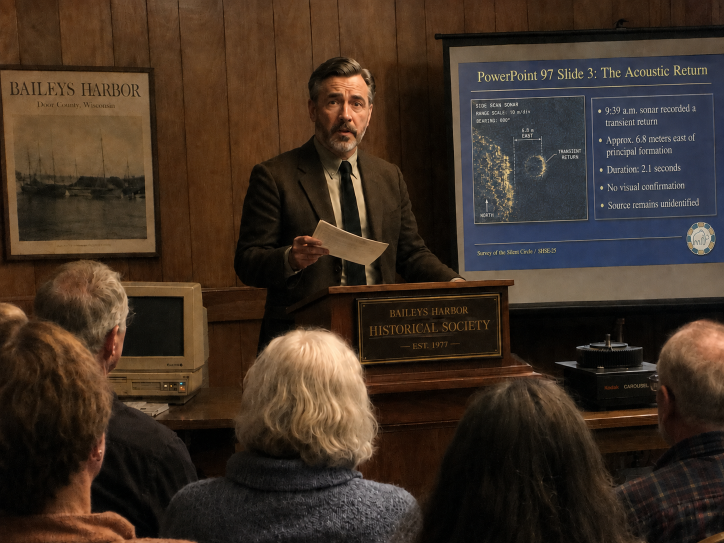
The Assembly Room occupies the eastern side of Baileys Harbor Town Hall. A low platform has been assembled beneath the municipal flag and a framed photograph of an earlier town board whose members appear unanimously suspicious of photography.
Seventy-two folding chairs face a portable projection screen. Sixty-eight are occupied. Four have been reserved for late arrivals, representatives of the press, and one person whose attendance was confirmed in two separate letters but who does not appear.
A Kodak Carousel projector stands beside the lectern. A modern laser projector supplied by the Great Lakes Research Consortium is connected to the Order’s official computer, a beige Gateway Pentium 5 desktop.
The Society’s refreshment table has been placed along the rear wall. Coffee, lemon bars, and several varieties of cookie remain covered until the formal interval.
Klara’s note: One attendee uncovered the molasses cookies before the lecture. No corrective action was taken, though the matter appears in the hospitality report.
Question cards have been placed beneath each chair. Attendees are instructed not to submit them until the designated interval.
A digital title slide waits upon the screen. The title is centered. The Order seal is not.
PowerPoint 97 Title Slide: The Silent Circle Survey
Good evening.
Madam President, members of the Baileys Harbor Historical Society, guests, and fellow students of the inland seas, thank you for receiving us.
The Order is especially grateful to the Town of Baileys Harbor for the use of this Assembly Room, and to Mrs. Helene Voss and the Society’s program committee for arranging this evening’s lecture.
I understand the room must be returned to its customary configuration before tomorrow morning’s parks meeting.
We have therefore recorded the original position of every table.
Alistar gestures toward a hand-drawn floor plan resting beside the lectern.
The chairs proved less cooperative.
I would also like to acknowledge the Great Lakes Research Consortium, whose cooperation made the Silent Circle Survey possible.
The GLRC provided the research vessel, sonar systems, navigation support, telemetry, weather monitoring, safety personnel, technical staff, and much of the data you will see this evening.
They also provided the laser projector.
The Order has provided the computer.
Alistar looks toward the beige desktop beside the screen.
It has served without serious incident since 1999.
Klara’s note: This statement remained accurate for approximately another fourteen minutes.
Tonight, I intend to give a factual account of the expedition conducted last autumn in Grand Traverse Bay. I will distinguish between what was measured, what was directly observed, and what members of the expedition later believed those observations might mean.
That distinction is essential.
It is also why the presentation was reviewed by three committees, two recorders, one technical adviser, and an emergency subcommittee convened after the map key was found to contain two different shades of blue labeled “deep water.”
The matter has been resolved.
A darker blue has been adopted.
We may begin.
The Kodak Carousel advances. A photograph of Grand Traverse Bay appears beneath a low gray sky.
PowerPoint 97 Slide 1: The Survey Site
The object of the expedition was a submerged stone formation lying at a depth of approximately forty feet.
Earlier bathymetric work had indicated an unusual alignment of large glacial stones. Some public accounts had already taken to calling the site the “Stonehenge of Lake Michigan.”
Neither the Order nor the GLRC adopted that description.
It is vivid, but it carries more conclusion than evidence.
The Consortium referred to the operation as SHSE-25.
The Order referred to it as the Survey of the Silent Circle.
Both names appear in the record, sometimes on the same page and, in one instance, in the same sentence.
Klara’s note: The disagreement remained administrative until Mr. Whitcomb ordered embossed expedition folders bearing the Order designation.
The next slide shows the research vessel tied at the pier.
The survey was conducted aboard the GLRC vessel Arcturus.
Director Rebecca Hemsdale retained operational authority over navigation, deployment, weather, safety, and recovery. Dr. Mason Liu supervised launch procedures and system coordination. Dr. Selene Armitage supported sonar calibration and telemetry analysis. Dr. Tobias Rehn assisted me in maintaining the joint expedition record.
The Order supplied the submersible Little Concord, analog survey materials, historical documentation, and the field observers.
I should be clear that the expedition could not have proceeded without the Consortium.
Their equipment produced the strongest technical record of the site. Their crew placed us safely over the survey area, deployed the submersible, maintained surface coordination, and recovered every participant and every major piece of equipment.
The Order’s disagreements with the GLRC came later and concerned interpretation, not competence.
Director Hemsdale nods once from the second row.
Klara’s note: Director Hemsdale’s nod was brief but unambiguous. At Alistar’s request, it was marked in the margin of the speaking copy.
PowerPoint 97 Slide 2: Departure and Descent
The joint party departed on the morning of October 22.
Conditions were overcast. Winds were easterly, between eight and twelve knots. Visibility was limited but workable. Surface temperature was approximately forty-eight degrees Fahrenheit.
At 9:07 a.m., Little Concord was deployed.
The slide changes to a photograph of the submersible being lowered into the water.
The descent was routine.
There was intermittent communication interference, but both digital and analog channels remained in service. The water darkened steadily as the submersible approached the target depth.
At approximately forty feet, the formation came into view.
The stones appeared arranged in a broad semicircle. Most were large glacial boulders, averaging roughly 1.2 meters in diameter. One slab bore visible linear scoring.
The GLRC’s preliminary assessment was that these marks were consistent with glacial abrasion and natural fracture lines.
The Order’s preliminary assessment was that intentional modification could not be ruled out.
Neither interpretation was adopted as conclusive.
Director Hemsdale and I agreed upon the phrase, “record, not interpret.”
It remains one of the most useful lines produced by the expedition.
Klara’s note: One question card was submitted at this point. It was returned unanswered with the designated question interval circled in red pencil.
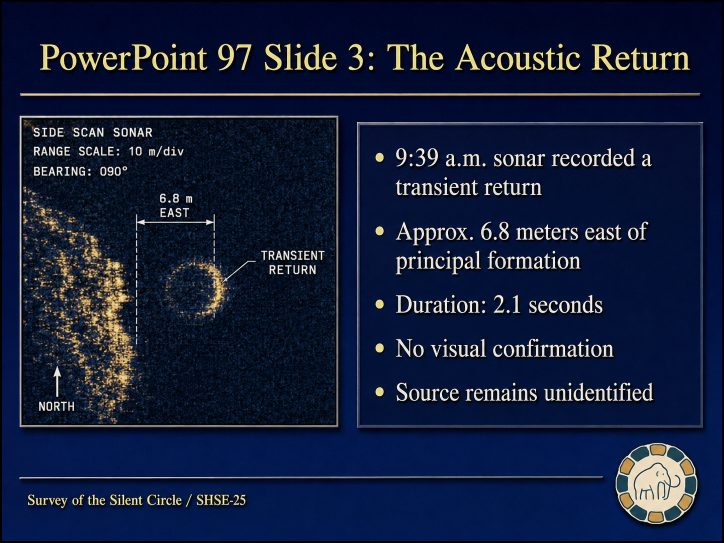
PowerPoint 97 Slide 3: The Acoustic Return
The carousel advances to a photographed sonar trace.
At 9:39 a.m., the sonar registered a transient acoustic return approximately 6.8 meters east of the principal formation.
The return lasted approximately 2.1 seconds.
There was no visual confirmation.
Its source remains unidentified.
That is the fact.
Descriptions such as “responsive,” “waiting,” or “aware” belong to later testimony. They are not instrument readings.
This distinction matters because the Order does not improve the record by making it stranger than it was.
The record is already sufficiently strange.
The laser projector activates. The Consortium’s digital sonar image appears beside the 35mm projection.
As you can see, the GLRC’s digital image is considerably clearer.
The computer freezes.
Or was.
The mouse pointer remains motionless. Mr. Whitcomb tries the keyboard.
No urgency.
We have the transparency.
The audience waits.
Klara’s note: The silence lasted twenty-three seconds. During that interval, six members of the audience looked toward the computer, three looked toward Mr. Whitcomb, and Director Hemsdale looked at Alistar.
The screen turns blue.
No one speaks.
We have now exceeded the expedition’s communications interruption by seventeen seconds.
There is restrained laughter.
Director Hemsdale, quietly:
“The Consortium laptop remains available.”
Thank you, Director.
The offer is acknowledged.
Mr. Whitcomb remains crouched beside the computer.
The presentation is already open on this machine.
Klara’s note: Mr. Whitcomb later maintained that reopening the presentation elsewhere would have introduced unnecessary version risk.
The blue screen remains visible.
That concludes the digital portion of the acoustic record.
The Kodak Carousel continues.
PowerPoint 97 Slide 4: The Six Seconds
During the survey, both primary communications channels ceased at the same time.
The interruption lasted approximately six seconds.
The systems had separate power arrangements, yet both registered the same interval of silence. The Arcturus logged a brief surge. Several frames of visual data were corrupted.
The GLRC attributed the interruption provisionally to an onboard electrical fluctuation.
The Order classified it as a synchronized anomaly pending review.
I proposed a more elaborate term at the time.
Eleanor Price advised that we call it silence.
Her wording has endured.
Mr. Whitcomb turns off the computer.
Klara’s note: The timing was unfortunate and has not been reproduced in rehearsal.
When the systems aboard Little Concord returned, the survey continued.
No damage was detected. The submersible remained operational and completed the first pass over the site.
Recovery began shortly after ten o’clock.
PowerPoint 97 Slide 5: Recovery
The carousel advances.
A photograph of the expedition luncheon appears on screen.
That is not the recovery.
The audience looks at the projected sandwiches.
Mr. Whitcomb?
A slide is removed and replaced.
Though the egg salad did worsen shortly afterward.
Klara’s note: The luncheon photograph had been filed under “Conditions Following Recovery.” The classification was technically defensible but unhelpful.
The correct slide appears, showing crew members guiding the submersible alongside the vessel.
At 10:15 a.m., Little Concord was recovered without injury or equipment loss.
Shortly afterward, weather conditions deteriorated sharply.
Wind increased. Rain reduced visibility. The water became rough enough that further dives were postponed.
Here the record becomes more difficult.
The instruments establish that a storm occurred.
They establish that it followed closely upon recovery.
They do not establish intention.
Eleanor Price later said:
“That storm wasn’t weather. It had timing.”
Mr. Whitcomb described the experience below as something closer to presence than pressure.
I recorded that the event felt less like warning than recognition.
These are serious statements made by experienced observers.
They are also subjective statements.
The Order preserves them because they belong to the expedition record. We do not present them as proof of anything beyond the impressions of those who were present.
The Windows 98 startup sound plays at full volume behind him.
Alistar waits for it to finish.
Thank you.
Klara’s note: The volume had been tested before the lecture. It had not been tested after restart.
PowerPoint 97 Slide 6: What the Expedition Established
The expedition established several things with confidence.
There is a submerged formation at the surveyed location.
It consists of large glacial stones in an apparent semicircular arrangement.
At least one stone bears visible linear markings.
A transient acoustic return was recorded nearby.
A six-second communications interruption affected multiple systems.
Minor digital corruption occurred.
A rapidly developing storm followed the recovery.
All personnel returned safely.
No artifact was removed.
No evidence presently establishes who arranged the stones, when they were arranged, or whether they were arranged at all.
No evidence presently establishes the source of the acoustic return.
No evidence presently establishes a causal connection between the survey and the storm.
Those limits are not a weakness in the account.
They are the account.
The purpose of a survey is not to return with the answer one hoped to find. It is to return with a better boundary between what is known and what is merely suspected.
That boundary is where the Order’s work now stands.
The next slide shows the expedition party after returning to harbor.
PowerPoint 97 Slide 7: The Order and the Consortium
The relationship between the Order and the Great Lakes Research Consortium deserves particular notice.
The GLRC asks what can be demonstrated.
The Order asks what has been remembered, neglected, or dismissed too quickly.
These are not always comfortable approaches to place beside one another.
They are, however, useful.
The Consortium protected the expedition from enthusiasm without method.
The Order protected it from method without memory.
The GLRC preserved the principal technical record.
The Order preserved the analog notes, personal testimony, historical context, and the details that instruments do not know to consider important.
Neither archive is complete on its own.
Between them lies the most honest account we can presently give.
The restarted computer resumes the presentation. A digital slide appears showing the expedition luncheon from a second angle.
That image remains outside the formal record.
Klara’s note: The unlabeled sandwich visible in the lower-left corner remained under inquiry until November.
Director Hemsdale, from the second row:
“The projector is not the expedition.”
No.
But it is now part of the record.
Mr. Whitcomb nods gravely.
Klara’s note: This exchange was later quoted in the minutes under “Discussion of Public Interpretation.”
PowerPoint 97 Slide 8: What Comes Next
The Survey of the Silent Circle is not complete.
The sonar records require further review. The corrupted material should be compared across systems. The linear markings deserve better imaging under improved conditions. The acoustic return should be tested against geological, biological, and mechanical explanations.
Any return to the site should again be conducted cooperatively, with proper safeguards, redundant records, and enough time allowed for the Order to revise the checklists produced after the last expedition.
There are currently eleven.
A voice from the side table speaks quietly.
Twelve?
Very well.
There are currently twelve.
Only four are considered final.
Klara’s note: There were thirteen by the time this transcript was approved. Checklist Twelve governs checklist consolidation.
Last autumn, our task was to reach the Silent Circle.
This year, our task is to preserve the record of what occurred there and place it before others without exaggeration, embarrassment, or premature certainty.
We know the formation is there.
We know we reached it.
We know that, for six seconds, every system agreed upon silence.
And we know that the lake offered no explanation.
That is not a conclusion.
It is a reason to continue.
Thank you.
I am prepared to take questions, subject to time, relevance, and the orderly circulation of the question cards.
There is applause.
Mr. Whitcomb attempts to illuminate the hall and instead advances the carousel to an upside-down photograph of a dock cleat.
Klara’s final note: The question period lasted forty-one minutes.
Eleven cards were submitted. Four were duplicates. Two were statements. One contained a drawing of the formation. One had been completed before the lecture began. Three complied fully with the instructions.
Questions concerned the stone markings, the storm, the acoustic return, the possibility of a second expedition, and whether the Windows computer had accompanied the original survey.
It had not.
During the computer restart, the emergency exit sign provided the only reliable illumination in the Assembly Room. Its operation was subsequently commended in a letter to the Town.
The room was returned to municipal configuration at 9:47 p.m. All tables were restored to their documented positions.
Three chairs could not be positively identified and were placed with the majority.
The upside-down dock cleat was later identified as Slide 62B and retained in the touring sequence because removing it would have required renumbering the carousel.