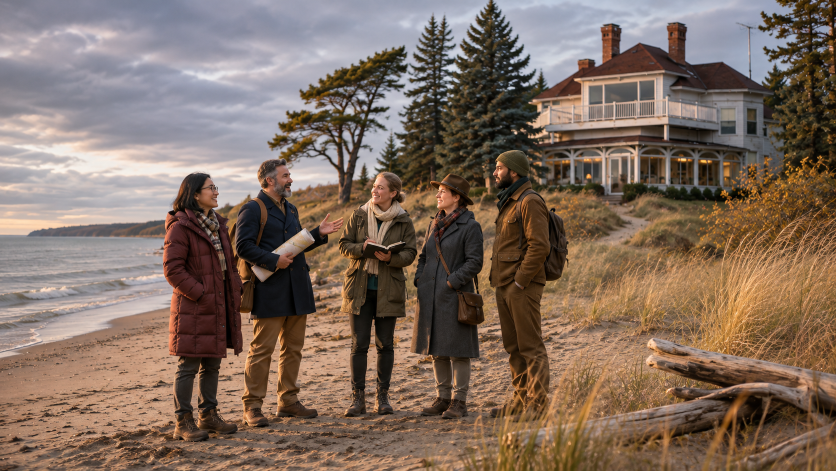

From the Membership: Autumn Research Notes
The transition to indoor operations has allowed several members to resume their individual research projects, many of which were temporarily set aside during the summer field season. Progress has been encouraging, although the customary disagreements over methodology, interpretation, and proper archival procedure remain unresolved.
Dr. Selene Armitage: Shipwreck Debris and the Problem of Identification
Dr. Armitage has been examining timber fragments recovered along the Manitowoc County shoreline, with particular interest in nineteenth-century fastening methods and the distinction between vessel construction materials and ordinary waterfront debris.
A recent specimen bearing two iron fasteners prompted considerable discussion after Armitage suggested it might represent a fragment of a commercial sailing vessel.
Further examination revealed it to be part of an agricultural wagon.
Armitage maintains that the identification was nevertheless valuable, as Great Lakes vessels and farm wagons occasionally employed remarkably similar joinery.
She has retained the specimen.
Gerald “Charts” Whitcomb: Historical Navigation on the Western Shore
Whitcomb continues his comparative study of nineteenth-century Lake Michigan navigation charts, examining changes in reported depths, shoreline features, and the positioning of navigational landmarks.
His latest work has identified a discrepancy of approximately 140 yards between two historical representations of Rawley Point.
Whitcomb has spent three weeks determining which chart is correct.
Captain Rowan Thorne has suggested that the lighthouse's present location might provide a useful starting point.
Whitcomb described this as “an unnecessarily contemporary approach to a historical problem.”
Klara Weiss: The Lost Language of Maritime Correspondence
Weiss has begun cataloging regional shipping correspondence from the late nineteenth century, focusing on the informal terminology employed by captains, chandlers, and harbor officials.
Her research has uncovered several colorful expressions for weather conditions, unreliable equipment, and difficult passengers, many of which appear to have disappeared from common use.
Particular attention has been given to a phrase found repeatedly in an 1888 captain's log: “a most disagreeable sea.”
Weiss has documented seven separate occurrences, each describing substantially different weather conditions.
Captain Thorne has offered to explain the expression.
Weiss has declined, preferring to preserve the historical interpretation.
Dr. Basil Cartwright: Ice, Timber, and the Winter Shoreline
Cartwright is preparing a study of how seasonal ice formation affects the preservation and movement of historic wooden material along the western shore of Lake Michigan.
His work involves comparing winter photographs, shoreline surveys, and historical descriptions of ice shove events near Two Rivers.
An early finding suggests that timber deposited during autumn storms may be displaced considerable distances by spring breakup, complicating efforts to establish an artifact's original location.
Cartwright has requested that members refrain from moving any potentially significant timber found during winter surveys.
This request follows an incident last February in which Gerald Whitcomb helpfully relocated a six-foot plank to the Chapter's equipment shed.
The plank remains there.
Its original location is now the subject of considerable debate.
Eleanor Price: The Cost of Exploring the Great Lakes
Price has undertaken a review of historical expedition expenses, examining how early scientific societies financed surveys, chartered vessels, and maintained field equipment.
Of particular interest is the remarkable proportion of expedition budgets devoted to transportation, accommodations, and food compared with actual scientific instruments.
A preliminary review of the Order's own historical accounts suggests that certain expeditions were notably well provisioned.
One 1906 shoreline survey included charges for two survey instruments, a hired launch, three nights' lodging, and an unusually substantial quantity of preserved peaches.
Price has requested clarification from the archives.
Klara Weiss has reminded her that the relevant treasurer died in 1932.
Edwin Barlow: Underwater Acoustics and the Winter Lake
Barlow has returned to his study of underwater sound propagation in the Great Lakes, particularly the acoustic effects of changing temperature layers, ice formation, and vessel activity.
His winter program will involve hydrophone recordings at several sheltered locations, with the objective of comparing contemporary underwater sounds against historical descriptions of unusual noises heard through lake ice.
During a preliminary equipment test, Barlow recorded a persistent low-frequency vibration that he initially attributed to distant commercial shipping.
After several hours of analysis, the source was identified as a nearby municipal pump.
Barlow has retained the recording as a useful baseline.
Thomas Ashford: The Great Lakes Coastal Survey of 1898
Ashford has begun reconstructing a little-documented shoreline survey conducted at the close of the nineteenth century, using surviving maps, local newspaper accounts, and correspondence between regional engineers.
His investigation has revealed several discrepancies in reported distances and the locations of temporary survey markers.
He believes the original survey team may have encountered significant difficulties with the equipment available at the time.
Whitcomb believes the survey team may simply have made mistakes.
The two have agreed to compare findings.
Their first discussion lasted nearly three hours and produced no agreement regarding the definition of a reliable measurement.
A second meeting has been scheduled.
Captain Rowan Thorne: The Practical Business of Winter
While the Chapter's academic members pursue their various investigations, Captain Thorne has concentrated on the winter maintenance of the Concord, the inspection of auxiliary equipment, and preparations for the coming spring season.
He has also reviewed the Order's cold-weather field procedures, with particular attention to vessel operations, shoreline access, and emergency communications.
Thorne's principal recommendation is that members conducting winter observations should dress appropriately, monitor weather conditions, and avoid unnecessary risks.
The Safety Committee has requested a more formal version of the recommendations.
Thorne has submitted the same three points in a larger font.
Alistar Corvus: The State of the Order
Chapter Steward Alistar Corvus has spent much of the autumn coordinating the Order's winter program, reviewing field reports, and preparing an updated catalogue of ongoing investigations.
He has expressed particular satisfaction with the variety of scholarly work currently underway, noting that the Order continues to provide a place for independent inquiry into subjects that might otherwise receive little attention.
He has also proposed a series of informal winter lectures, allowing members to present findings and discuss future research.
The first, tentatively scheduled for December, will concern historical navigation practices on Lake Michigan.
Whitcomb has requested ninety minutes.
Alistar has approved twenty.
Negotiations continue.