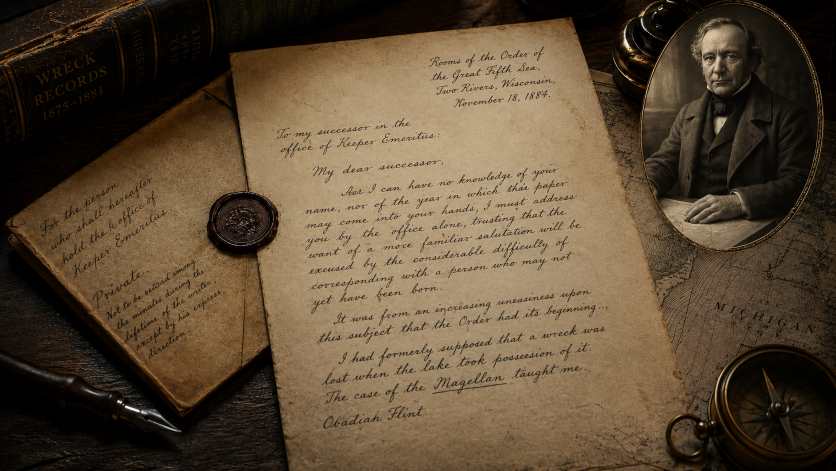

While reviewing the Order’s earliest wreck records, I found this sealed 1884 letter lodged behind the papers concerning the Magellan. It was written by our founder, Obadiah Flint, to a future Keeper Emeritus.
Transcribed by Klara N. from the original manuscript. *Note image is an artistic rendering of the letter due to the Order's camera undergoing maintenance
Alistar Corvus
Keeper Emeritus
Upon the outer envelope, in the hand of Obadiah Flint
For the person who shall hereafter hold the office of Keeper Emeritus.
To be opened when some account of the Order’s first intention may be judged useful.
Private; and not to be entered among the minutes during the lifetime of the writer, except by his express direction.
Rooms of the Order of the Great Fifth Sea
Two Rivers, Wisconsin
November 18, 1884
To my successor in the office of Keeper Emeritus:
My dear successor,
As I can have no knowledge of your name, nor of the year in which this paper may come into your hands, I must address you by the office alone, trusting that the want of a more familiar salutation will be excused by the considerable difficulty of corresponding with a person who may not yet have been born.
Neither can I know the condition in which you shall find the Order. It may by that time have acquired some standing among the societies of the Lakes, or it may remain much as it is at present, with six members, a small balance in the Treasurer’s box, an account outstanding for lamp oil, and a cabinet whose lower door can be opened only after several days of dry weather.
Whatever condition has been allotted you, I offer my sympathy.
We are now in the second complete year of our existence. There are six members in regular attendance, and, as there are likewise six offices, every member bears a title. This arrangement has not greatly enlarged our dignity, but it has prevented any serious distinction from arising between those who direct the work and those who are obliged to perform it.
Our rooms are lent to us. The table is made of two smaller tables which differ somewhat in height, and of the six chairs only four may be occupied without reflection. A fifth requires a certain management of the body. The sixth has been committed to the Committee on Furnishings, whose report is awaited.
The stove draws badly whenever the wind is easterly; the lamp nearest the north wall smokes; and the great map of Lake Michigan has twice fallen during debate, on both occasions at a moment which several members thought deserving of notice. The Recording Secretary, whose attachment to natural causes is not easily shaken, entered each occurrence as accidental.
These particulars may appear mean to you, especially if the Order has since obtained accommodations of its own; nevertheless, I confess that I have seldom entered any apartment with a greater sense of satisfaction.
Beyond our windows lie the river and the yards, the mills and shops, the fishing craft, the schooners, and the steam vessels which increase in number with every season. In the morning there comes up from the waterfront the sound of saws, mallets, wagon wheels, whistles, and those disputes by which men engaged in useful labor commonly enliven the beginning of the day. When the evening is clear, the light at Twin River Point may be seen to the northward. When the wind is strong from the lake, the glass in our windows begins to complain before the members do, though I cannot say that it always enjoys a considerable advantage.
It is an age greatly occupied with improvement. Railways join towns which, within the recollection of men still living, were thought distant from one another. Steam prevails where sail formerly held the greater part of the field. Harbors are enlarged, channels deepened, forests reduced, manufactories established, and vessels built upon a scale which would have astonished the mariners of an earlier generation.
I do not write this in contempt of improvement. I have travelled by railway and found it superior to mud; and I have stood aboard a steamer which made good progress against a wind that would have sent an older vessel in search of shelter.
Still, the advance of one age has a manner of destroying the evidence of the age which went before it. An old vessel is broken and her papers dispersed. A keeper dies, and the observations of thirty years are burned with the refuse of his household. A fisherman leaves the water, and with him goes a knowledge of shoals, currents, fogs, and weather which no chart has preserved. Ice alters a wreck; storm alters a beach; and an old name, having been judged insufficiently elegant, is replaced by another which conveys less meaning.
Narratives are no more fortunate. They are copied, amended, shortened, reconciled, and rendered respectable until they bear a pleasing agreement with what sensible persons suppose must have occurred. In this way an imperfect account may acquire dignity, while an inconvenient truth, being badly expressed or delivered by an unimpressive witness, is permitted to die.
It was from an increasing uneasiness upon this subject that the Order had its beginning.
Among the earliest papers in our possession you will find several relating to the Canadian schooner Magellan, which was lost off Two Rivers in the storm of November, 1877, while bound from Chicago toward Toronto with a heavy cargo of corn. None of her people survived.
The wreckage which came ashore was greatly broken, and the condition of the timbers and of the recovered dead caused many persons to believe that the schooner had been run down. The propeller Joseph L. Hurd was reported to have passed through rigging or wreckage upon the same night. Some declared that the matter admitted of no further doubt. Others maintained that the Magellan had already foundered, and that the propeller had encountered only what the lake had left upon the surface.
Each account soon gathered its partisans; and each partisan, after repeating his opinion a sufficient number of times, came in time to remember it as knowledge.
I was aboard neither vessel, nor did I see the Magellan during her last hours. It would therefore be presumptuous in me to pronounce upon a question which those nearer the event were unable to settle. What remained in my mind was not only the melancholy loss of the schooner and her company, for this lake provides such instruction in humility with a frequency no thoughtful man can overlook. I was more disturbed by the rapidity with which knowledge of the occurrence divided itself into separate and uncommunicating parts.
The owners possessed one account, the underwriters required another, and the newspapers printed what might be obtained before the succeeding issue. Men upon the shore remembered lights, weather, sounds, or wreckage, according to their situation. Fishermen repeated what they believed they had seen; and other persons repeated the fishermen, generally with some improvement in arrangement. Families possessed private letters which might have altered the meaning of the public reports, but no public office had occasion to ask for them.
A keeper knew one part of the matter, a sailor another, and a carpenter perhaps another; while a widow, who had no official standing whatever, might possess the sheet of paper by which the three could have been understood.
It did not appear to me that these persons were dishonest. Each had received some part of the event, together with such inference, fear, pride, or later recollection as human nature commonly supplies. The difficulty lay in the circumstance that no person possessed the whole, while every fragment, considered by itself, appeared to demand a conclusion which the whole might not have supported.
I therefore began, in a private and rather disorderly manner, to collect what I could. I copied notices from the newspapers, wrote to persons at other ports, took down recollections, and, whenever circumstances permitted, returned after some interval to put the same questions again. I compared dates, names, winds, cargoes, reported bearings, and descriptions of wreckage.
From this work I received several lessons which have since governed my conduct.
Memory does not commonly fail as a lamp is extinguished, at once and visibly. It changes little by little, often gaining brightness and arrangement as it loses accuracy. Men also cease to report unusual things when every uncommon statement is met with laughter. A witness may be mistaken concerning time, distance, direction, weather, or sound; he may confuse what he observed with what he afterward heard. None of this can be discovered, however, by informing him beforehand that he is a fool.
By the time I had learned how the record ought to have been made, much of it could no longer be recovered. One man had left the county; another was dead; a third could not distinguish what he had witnessed from what had been told him in the years following. Papers had disappeared, and pieces of timber had been carried away for souvenirs or firewood. Meanwhile the explanations had become more certain, as though the want of evidence had relieved every person of the necessity of caution.
I had formerly supposed that a wreck was lost when the lake took possession of it. The case of the Magellan taught me that it may be lost a second time upon land, through neglect, vanity, imperfect recollection, and the preference, common to most men, for an account which is settled over one which remains merely true.
It was this experience, and especially the knowledge that much which might once have been secured was already beyond recovery, which persuaded me that some continuing association was required.
In the winter of 1881, I asked five persons to examine the collection with me. They were not chosen because they agreed with one another, agreement being of great comfort at supper but of rather less value in inquiry.
One understood vessels and their construction; another knew the fishing grounds and the changes of weather along this coast; a third possessed an orderly hand and a memory superior to mine; another could write to distant persons without giving unnecessary offence, a faculty which I had already proved wanting in myself; another understood accounts and would not permit enthusiasm to expend money which did not exist; and the last retained the uncommon ability to ask a plain question after the rest of us had made the subject needlessly learned.
I contributed the papers and the use of the room. My associates have since maintained that I contributed also the needless learning.
Our first meeting was informal. The greater part of the second was occupied in determining that the first had been informal. At the third, a committee was appointed to prepare a constitution. It produced eleven Articles, which were debated through four evenings, enlarged by three, diminished by two, and completed by the restoration of one provision under another title. The instrument was then adopted unanimously, several members having by that time forgotten the particular objections with which they had begun.
In this manner the Order of the Great Fifth Sea came into existence.
The name was not adopted because we supposed Lake Michigan unknown to geographers. It was chosen because those who live upon an inland sea are frequently informed by persons at a distance that they live beside no sea at all. A man who has lost sight of land upon it, waited upon its ice, labored against its weather, recovered its dead, or watched a November sea break upon the shoals at Twin River Point has little need of instruction upon this point.
We called ourselves an Order partly from amusement and partly from hope. A club may be formed for present enjoyment and dissolved when the enjoyment changes its object. A society may collect papers, hear addresses, and publish proceedings. An Order appeared to imply that something had been placed in our charge, to be received from those before us and delivered, in as good a condition as circumstances allowed, to those who should follow.
We possessed no authority to give ourselves so grave a character. It seemed useful, however, to proceed as though the work might outlive the persons who began it. The existence of this letter will show you that I continue to cherish that expectation, though I should be embarrassed to confess it at a regular meeting.
The purposes of the Order are set forth in the constitution at greater length and with considerably more ceremony. As the committee which composed that document included myself, I may say without disrespect that its language occasionally conceals what it was intended to declare.
We are, before all else, to preserve an account before we undertake to explain it. What was seen should be distinguished from what was supposed; what was heard directly from what was repeated; and an original statement from a copy, however handsomely the copy may have been written. Where two honest narratives cannot be reconciled, both ought to remain. A clerk who removes a contradiction commonly believes that he has repaired the record, when in truth he has repaired only its appearance.
We are also to bring together things which ordinary business keeps apart. Government reports, vessel papers, newspaper notices, private journals, family letters, charts, wreckage, old place-names, and the knowledge of those who work upon the shore are each preserved for a different purpose. The public record is not false because it is incomplete; it becomes misleading only when men forget the purpose for which it was made and suppose it to contain the whole.
Nor should our attention be confined to persons whose position gives their words an appearance of authority. Education may enable a gentleman to give greater order to his account; it cannot place him nearer the occurrence than the sailor, mechanic, or fisherman who stood upon the spot. A keeper’s assistant, a deckhand, the woman who preserved the letters, or the child who noticed what the adults had overlooked may possess the part without which the remainder cannot be understood.
This does not require us to believe every narrative offered. Courtesy and credulity are not the same virtue. It requires only that an account be received accurately, considered fairly, and not rejected merely because the person who brings it owns no impressive coat.
We must likewise preserve, so far as possible, the connection between an object and the place from which it came. There is at present a great appetite for cabinets. Stones, implements, timbers, fragments of vessels, and every manner of curious article are removed from their situations and displayed as evidence of learning. Yet, if no proper account accompanies them, they soon retain little beyond their substance.
A stone removed from its setting becomes chiefly a stone and, after a time, an inconvenience to the person obliged to dust it.
We maintain a cabinet because certain articles must be secured, and because even a modest society is expected to possess something behind glass; but the cabinet is not the object of the Order. What we are charged to keep is the connection of the object with its place, the testimony with its witness, the wreckage with its vessel, the name with its map, and the narrative with the conditions under which it was received.
The Order must also endeavor to be useful. There is no merit in leaving a subject mysterious merely because mystery pleases the imagination. If an inquiry discloses a hazard, the proper officer should be informed. If a chart appears wrong, the correction should be submitted. If a family seeks the history of a lost vessel, the records should be opened. If the public disclosure of a place would invite injury or plunder, restraint is not secrecy for its own sake, but a duty.
Field work ought also to be undertaken with ordinary prudence. A sound boat, dry matches, a proper bearing, and food for one day beyond the intended return are of greater service than the finest theory. This provision was added after our first excursion, when the Secretary for Field Inquiry brought three notebooks, two compasses, a measuring chain, sealing wax, and a waterproof envelope containing our written authority to act, but nothing which could be eaten.
The regulations were amended at the next meeting.
There remains one purpose which, to my mind, gives meaning to all the others. The Order exists in order that an inquiry may continue after the person who began it has laid down his pen.
The life of an individual is short, the memory of a community uncertain, and the lake keeps much of its history in places not easily entered. We shall not answer every question placed in our books; indeed, it is possible that we shall answer very few. We may nevertheless leave each in better condition than we received it, with its sources named, its contradictions preserved, and its uncertainties honestly marked.
Among the accounts now retained in the cabinet is one concerning a supposed arrangement of stones beneath the Great Lake, called in several of its versions the Silent Circle. I possess no evidence sufficient to establish the story, nor do the versions agree. Some speak of a circle, others of a line or a place of turning. They describe a country where there is now only water, and a road in a place where no vessel can cast anchor.
A prudent man may dismiss the whole as fable. A man of another disposition may declare it an ancient revelation, appoint himself its interpreter, and begin at once to collect subscriptions. Neither course appears to me necessary.
The account has therefore been marked Unproved and retained. If sufficient evidence should ever bear upon the matter, it ought to be judged upon its own character. The earlier narrative must not be altered merely so that it may agree more handsomely with whatever is afterward discovered.
If the Order acquires a reputation, that reputation may prove among its more serious dangers. There will always be persons who value the good name of an institution more than the conduct by which the name was earned. They will recommend that doubtful matters be omitted, troublesome witnesses avoided, and contradictions softened. Their advice will usually be offered under the name of prudence.
You must remember that the dignity of the Order lies chiefly in the honesty of its record, and not in the agreement of its members.
Neither are you bound to defend the conclusions of the founders. You are bound only to examine them. If I have been mistaken, you will do me no injury by correcting the error. A founder who demands the perpetual agreement of his successors has established something other than an association of inquiry.
As for our ceremonies, preserve them where they continue to bear some meaning, but do not be too greatly impressed by their antiquity. Customs arise more easily than explanations.
The formal knock upon the cabinet door originated because the latch was troublesome. The pause before the reading of field notes began when damp pages were placed near the stove. The Keeper’s coat was furnished with interior pockets because I had formed the habit of losing pencils.
It may be that these practices shall acquire dignity with age. If so, regard them with affection, but not with awe. A tradition is useful while it carries some remembrance of its origin; when the remembrance has been lost, the tradition may become only an elaborate manner of forgetting.
There is one further counsel which may appear less grave, though I do not think it less important. Do not allow the Order to become so consequential that its members cease to take pleasure in one another’s company.
Our six members disagree often, sometimes with vigor, and now and then upon matters so slight that an outsider might suppose the dispute contrived for amusement. Yet when weather threatens, when a family requests a record, when an elderly witness must be visited, or when an excursion begins before daylight, all six may be depended upon.
There is a peculiar comfort in finding five other persons whose oddities are differently arranged from one’s own. In choosing those who shall come after us, seek persons who observe carefully, inquire without vanity, admit an error without requiring a ceremony for the purpose, and remain useful when the weather is bad.
At present our possessions consist of twelve wreck accounts, copies from three journals, several charts, one box of correspondence, two shelves of newspaper extracts, four completed examinations of the shore, an unfinished index, and a measuring chain which was lost, recovered, and afterward made the subject of a committee inquiry.
This may not appear a considerable achievement, and perhaps it is not. Still, there are papers in our cabinet which would otherwise have burned; accounts in our books which would otherwise remain only in memories already failing; names secured to places which may soon be known by other names; and questions preserved without the addition of answers invented merely for the comfort of the reader.
We have made a place where a person may bring an uncertain thing and be heard with seriousness, though without being promised belief. For the present, I think that sufficient justification for the room, the dues, the lamp oil, and a quantity of parliamentary exertion which I shall not attempt to defend.
What the Order may become I cannot tell. It may dissolve after a dispute respecting the ownership of the cabinet. It may remain small and be known chiefly to those who have occasion to seek its help. It may continue after those who founded it have become no more than names entered upon an old page.
I do not chiefly desire that it shall become large. I should rather have it become worthy of confidence.
I should like a fisherman to know that he may report what he has seen without first preparing himself to be laughed at; a family to know that papers entrusted to us will not be lost, altered, or displayed without permission; and any person, however modest his station, to know that a fact which does not agree with the accepted account will not, for that reason alone, be refused a place in the record.
I hope also that the Order may assist men of science without pretending itself superior to science; that it may preserve history without reducing it to an ornament; that it may respect tradition without surrendering judgment; and that it may receive the strange and wonderful without abandoning ordinary sense.
More than this, I hope the work shall continue after we are gone.
The lake is large, and human recollection is brief. Public attention must pass onward to the next wreck, the next storm, and the next undertaking. The Order may remain when attention has moved elsewhere. It may gather that which has been separated, preserve that which cannot yet be judged, and place in the hands of another generation an inquiry still capable of being pursued.
You, who now read this, belong to that generation.
I shall never know you. You know me only because I have placed my name upon more papers than necessity required. Yet, if this letter has reached the person for whom it was intended, we have been engaged upon the same labor, and the years between us are not altogether an interruption.
Carry forward what remains sound; correct what has proved mistaken; preserve what is still uncertain; and leave your own account in such order that the Keeper who follows you may distinguish what you discovered from what you desired to discover.
Take care of the papers, particularly in damp weather. Be patient with witnesses, and less patient with conclusions which have become comfortable merely through age. Keep among your associates those whose company improves the labor, for an Order whose members avoid one another will soon find reasons to avoid the work as well.
Remember, finally, that we did not establish this body in the hope that men of a later age would admire it. We established it in the hope that something which deserved remembrance might thereby be preserved until better evidence, greater knowledge, or a more fortunate inquirer should make its meaning plain.
I remain, my unknown successor, with sincere respect, and with such confidence as I am able to place in the durability of properly indexed paper,
Your obedient servant in the work,
Obadiah Flint
Founder and Keeper Emeritus
Order of the Great Fifth Sea
P.S. The Treasurer informs me that the balance in his keeping is not seven dollars and some cents, but seven dollars and thirty-five cents, two new pen-points having been purchased since his last report. I make the correction here, as he declines to permit the matter to remain inaccurate merely because it is private.
P.P.S. The Committee on Furnishings has considered the sixth chair. It recommends that the same be reserved for Corresponding Members, none of whom is presently expected.
O. F.