
Field Log Addendum 22-C
Recorded by: Elenor Price
Location: Rawley Point Chapter House
Filed: May 8
Subject: Powered Parachute Drift Event, Rawley Point to Ludington
By early May, the powered parachute had become one of those Chapter House facts everyone pretended was under control because no one had the energy to keep being alarmed by it.
This is how trouble usually enters the Order. Not dramatically. Not through defiance shouted across the Bathymetric Hall. It arrives through familiarity. A strange object becomes a regular object. A bad idea becomes a procedure. A procedure becomes a binder. Then one morning Gerald Whitcomb is four miles offshore in a powered parachute and everyone is looking at one another as if this outcome had not been sitting patiently in the room the entire time.
To be fair, Charts had improved since the first flight.
That first attempt had been sketchy enough to make even Alistar go quiet, which is never a promising diagnostic sign. The canopy had surged. The trike had lurched. Charts had made a low, wobbling pass along the beach with the grim concentration of a man trying to negotiate with gravity in real time. Afterward, the machine was grounded for review, though in Order practice “grounded for review” means the guilty party gains access to a clipboard and gradually talks everyone into a second chance.
Charts did not waste his second chance. He read manuals. He watched training videos. He produced weather sheets, inspection forms, and an increasingly elaborate launch checklist. The Carriage House bench disappeared beneath fuel logs, wind notes, printed lake forecasts, and diagrams of the shoreline flight corridor. He became less reckless, which was both good and dangerous. Reckless people are easy to stop. Improving people are much harder.
By the week of the incident, he had completed several short morning flights along the Rawley Point shoreline without notable disaster. The launches were clean. The landings were acceptable. He kept close to shore. He used the radio. He even stopped referring to the powered parachute as “aerial littoral capacity,” at least when Alistar was within hearing distance.
So when he announced a short dawn observation run north along the shoreline, no one objected with sufficient force.
That was our first failure.
The morning was unusually calm. Lake Michigan had that early-season stillness that looks trustworthy from land and means almost nothing once one is above open water. The sky was pale and clean. The air near the Chapter House barely moved. Farther offshore, early season salmon sport fishing boats had already begun working the water in scattered lines, their navigation lights fading as the sun came up.
Charts launched shortly before six from the lower meadow.
I watched from the Observation Spire while sorting notes for the shoreline preservation meeting. The canopy inflated cleanly. The trike rolled, lifted, and settled into a steady northbound track. It looked, against my better judgment, almost competent.
There are many sentences in life one should hesitate to think. “It looks almost competent” is one of them.
The first concern came over marine radio at approximately 6:40. Silas picked it up from one of the early season salmon sport fishing boats working offshore north of Manitowoc. The captain did not sound alarmed. He sounded like a man trying to decide whether what he was seeing belonged to normal lake activity or to the Order, which is unfortunately a useful distinction.
He asked whether anyone from Rawley Point had eyes on “the parachute fellow,” and whether he was expected to be that far off the beach.
At first, this did not cause full alarm. Local boats had seen Charts several times by then, and a few of the captains had developed the tone people use toward a familiar eccentric hazard. They were not dismissive exactly. More like men watching someone back a trailer badly at a public launch. Concerned, but not yet committed to intervention.
A second boat called ten minutes later.
Then a third.
The reports agreed on one point. Charts was no longer tracking north along the shoreline. He was moving east.
Silas and I went to the bluff with binoculars. The powered parachute was still visible, though small by then. The canopy looked stable. He was not descending. There was no obvious mechanical failure. That made the situation worse in its own quiet way. A machine in distress gives everyone something to act upon. A machine calmly drifting toward Michigan asks only that one stand there and feel stupid.
Charts later explained, with diagrams, that the wind above the near-shore layer differed from what he had observed at ground level. Once he moved beyond the immediate protection of the shoreline, the offshore flow had more influence than expected. The powered parachute could turn and crab against it, but it did not have enough forward speed to overcome the drift.
In plain language, the lake was taking him.
The next hour had the strange, flattened quality of a problem becoming official.
Alistar was called from the Chapter House. Klara began taking notes because Klara takes notes even when the notes are essentially “Gerald is leaving Wisconsin by air.” Basil arrived wearing the expression he reserves for modern equipment and weak tea.
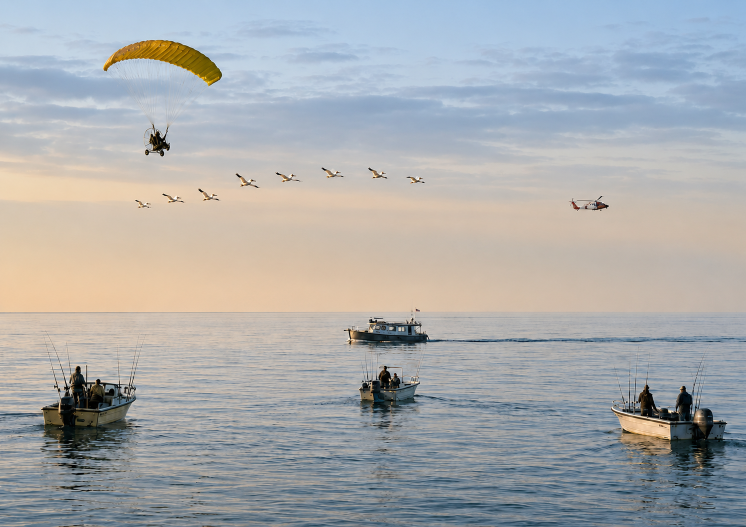
The salmon boats did not chase him so much as organize around him. One altered course enough to maintain visual contact. Another remained farther north and relayed position estimates. A third, already trolling an east-west line, became briefly and accidentally useful. Their radio traffic stayed calm and practical: bearing, estimated altitude, engine noise, distance from shore, whether the canopy appeared stable, whether the pilot was waving intentionally or merely being Gerald.
It was the most effective committee the Order never formed.
Then, according to one captain off Two Rivers, Charts began what was later described as “a series of altitude corrections.”
This is the polite term.
The less polite term is dipsy-diving.
The powered parachute dropped, rose, dropped again, and then swung through an uneven arc that appeared, from shore, either intentional or deeply regretted. Charts later claimed he was attempting to test lift in different air layers. This may even be true, though he did not describe it that way over the radio at the time. Over the radio, he mostly said things like “correcting,” “recovering,” and once, with worrying clarity, “that was not desired.”
A flock of pelicans then joined the matter.
I wish that sentence were decorative.
They appeared from the north, low over the water, moving in their usual prehistoric formation with the calm authority of creatures that have seen several human empires come and go and were not impressed by any of them. For several minutes they flew beneath and slightly behind Charts, following the same general eastward track. From shore, the effect was almost ceremonial.
Silas lowered the binoculars and said the pelicans had formed an escort.
No one contradicted him.
By this point, The Concord was still docked at Manitowoc Marina, where it had been since the prior weekend following maintenance and provisioning. That fact, ordinarily an inconvenience for scheduling, became useful at once. Alistar sent the order to scramble from Manitowoc rather than Rawley Point, while Klara coordinated with the marina office and Silas continued relaying observations from the Chapter House.
There was something very Order-like about the arrangement: one member in the Observation Spire with binoculars, one at the radio desk taking notes, one vessel launching, and Charts somewhere above Lake Michigan proving that local geography remains undefeated.
I left for Manitowoc with Alistar and Basil shortly after seven.
By the time we reached the marina, the situation had acquired a quality no one in the minutes would later know how to categorize. Charts was drifting toward Michigan under a yellow canopy. Early season salmon sport fishing boats were maintaining a loose visual net below him. A flock of pelicans had taken partial interest. The Coast Guard had been notified. Somewhere in the middle of all this was a man who, only six weeks earlier, had argued that powered parachutes were “operationally modest.”
The Concord cleared Manitowoc Marina under a low engine note and a mood that was too tired for panic. Panic would have been easier. Panic has energy. This felt more like resignation with diesel under it.
From The Concord, the scale of the situation became clearer. Charts was farther out than he had ever intended to be, and every minute made recovery more complicated. He remained on radio, reporting engine status, fuel, and heading in a clipped, careful tone. He sounded calm in the way people sound calm when they are building a wall inside themselves and hoping it holds.
The Coast Guard became involved once the informal tracking by fishing boats was no longer enough. Nobody had declared a crash, a ditching, or even a formal distress condition. That was part of the difficulty. Charts was airborne, responsive, and technically operating. He was also being carried across Lake Michigan in a machine that had not been prepared for a cross-lake flight.
That combination seems designed specifically to annoy agencies with responsibility.
Command routed through Commander Jane Greene, whose previous contact with the Order had already given her more context than any public servant deserves. Her voice over the radio was controlled, professional, and tired in a way I recognized immediately. Not angry. Not surprised. Worse than both. Familiar.
She did not dramatize the situation. She established facts.
Had Mr. Whitcomb filed a flight plan?
He had not.
Was there a planned landing site in Michigan?
There was not.
Was the aircraft equipped for a water landing?
There was a pause before Alistar answered.
It was not.
Another pause followed. Then Commander Greene directed the fishing boats to maintain safe distance, keep visual contact only if it did not interfere with their own operations, and report any change in altitude, engine sound, or control stability. She also requested that The Concord continue east but not attempt anything theatrical.
This last instruction felt personal.
The helicopter was dispatched from the Michigan side not as a chase vehicle, but as a moving safety envelope. That was how Greene described it later, and I appreciated the phrase because it made the whole business sound less like a circus with rotor blades.
By then, several boats were maintaining loose visual contact with Charts. The scene, from a distance, must have looked almost peaceful: a yellow canopy over blue water, sport fishing boats below, The Concord pushing east from Manitowoc, the pelicans briefly reconsidering their involvement, and the helicopter arriving from the Michigan side.
But there was nothing peaceful in the feeling of it. Charts had not intended to cross Lake Michigan. He had not prepared to cross Lake Michigan. Yet Lake Michigan, which has never cared much about intent, continued moving him in that direction.
The radio exchanges with Charts became shorter as the morning wore on. He reported that he was attempting to hold altitude and conserve fuel. He reported reduced ability to correct west. He reported that Ludington appeared to be the most practical landing option if the wind continued.
That was the moment the absurdity fell away for me.
For all the comedy of Charts and his binders and his enormous talent for accidentally escalating situations, he was alone in a small aircraft over cold water, trying to make the least bad decision available. It is easy to be irritated with him from shore. It is harder once the horizon has swallowed the shoreline and the choices have narrowed.
The helicopter reached visual contact before we did. Commander Greene relayed that Charts appeared stable and responsive. The Coast Guard began giving him practical guidance toward open landing options south of Ludington while keeping enough distance not to disturb the canopy. The fishing boats peeled back as he neared shore, except for one captain who stayed on station outside the traffic area and continued providing wind observations with the calm pride of a man who had not asked for this assignment but had accepted it.
Near shore, the wind finally began to favor him. Charts regained enough control to set up a descending approach south of the harbor. Unfortunately, by then he was low enough that the aircraft encountered gusty air coming off the shoreline and began another sequence of corrections that looked, to the untrained eye, like a folding lawn chair making moral decisions.
The landing was safe.
It was also wet.
Charts touched down at the edge of a low, grassy shoreline area where standing water had collected from recent rain and lake spray. The rear wheels hit first, then the front, then the entire trike slewed gently sideways into a shallow puddled stretch with enough force to soak both pilot and machine but not enough to injure either. The canopy collapsed behind him across the grass and water like an exhausted tent.
No injuries were reported.
That remains the most important sentence in this entire account.
Unfortunately, the matter did not end there.
Once on the ground, Charts moved immediately into what he later described as “post-landing emergency protocol.” This protocol apparently included deploying a handheld signal flare despite the fact that he was already visible to the Coast Guard helicopter, local responders, The Concord, and several sport fishing boats that had been monitoring him for much of the morning.
The flare fired cleanly.
Too cleanly.
It rose cleanly, angled toward the helicopter’s operating area, and burned out over the water before anyone had to do anything dramatic. The helicopter was not struck. It did not have to make an evasive maneuver. But it did shift position with the deliberate care of a crew deciding, collectively and immediately, that Gerald Whitcomb had exhausted his remaining goodwill.
Commander Greene’s voice came over the radio shortly afterward.
It was calm.
That made it worse.
She asked Alistar to confirm that Mr. Whitcomb had landed safely.
Alistar confirmed.
She then asked whether the flare had been intentionally discharged after landing.
Alistar looked at me, then at Klara, then toward shore.
He confirmed that it appeared so.
When Commander Greene responded, her tone had become very procedural.
We reached Ludington later that afternoon. Charts was sitting near the folded canopy beside a maintenance shed, damp from the waist down, drinking coffee from a paper cup and looking as though someone had removed most of his internal architecture and replaced it with weather data.
Commander Greene met us near the harbor office. She was courteous, but her patience had the thin, bright edge of something nearly spent. She explained that the Coast Guard did not wish to become a recurring support branch of the Order’s aviation experiments. She also explained that emergency signaling devices should be used to communicate distress, not to commemorate survival after every visible person in two states had already located you.
Alistar received this with appropriate humility, which is to say he looked like a man accepting a bill he had personally caused.
Charts apologized several times. Quietly. Properly. Not defensively.
That helped.
A little.
The powered parachute itself had to remain in Michigan temporarily, secured under local supervision until proper trailering could be arranged. This produced a new administrative problem, but by then everyone had exhausted the emotional capacity required to react to those. The machine was no longer the priority.
Charts was.
He returned to Wisconsin aboard The Concord.
The crossing took several hours.
It is possible to imagine that a long boat ride across Lake Michigan after an accidental airborne crossing would offer a man time for reflection. In Charts’ case, it offered reflection, damp socks, and the exquisite punishment of sitting quietly among people too fond of him to mock him properly.
He sat aft for much of the return, wrapped in a spare jacket, his shoes set near a vent in the practical but hopeless manner of wet shoes everywhere. Klara brought him coffee and did not ask whether he wanted to discuss the incident. Basil stood nearby for a while, clearly manufacturing several remarks and then, to his credit, swallowing most of them.
Alistar remained at the helm longer than necessary.
No one called it a ride of shame.
No one had to.
The lake handled that for us.
About an hour west of Ludington, Charts asked quietly whether the crossing demonstrated anything useful about endurance range.
Klara looked at him for a long moment and said that accidentally surviving a test is not the same as conducting one.
He nodded once and did not argue.
A little later, Basil asked whether the pelicans should be listed as independent witnesses.
That was the first time Charts smiled.
Only briefly.
But it counted.
The rest of the trip passed in the low engine note of The Concord, the slow return of the Wisconsin shoreline, and the kind of silence that follows fear once it has nowhere left to go. Charts watched the water for most of it. I sat near him for part of the crossing, not because he needed conversation, but because sometimes sitting near someone is the only useful thing to do.
At one point he said the lake had looked beautiful from above.
I told him I believed him.
And I did.
That is the difficult part with Charts. His judgment can be infuriating, but his wonder is real. He does not go up because he wants attention or because he enjoys frightening people. He goes up because the shoreline from the air shows him something the maps cannot quite hold. He sees the curve of the coast, the shoals, the color changes over depth, the long pale seams of sand moving under the water. He sees the lake as a living document.
Unfortunately, he sees all this while suspended beneath a fabric wing attached to a motorized chair, and the rest of us are left trying to keep him from becoming a footnote.
We reached Manitowoc Marina after dark.
The powered parachute did not.
That absence was noted by several members waiting near the dock, though wisely no one said anything until Charts had gone below.
Later that evening, after we returned to Rawley Point by road, I found him in the Carriage House reorganizing radio batteries. The powered parachute space looked suddenly smaller without the machine in it. He had already started a new checklist, because of course he had. Charts does not process fear directly. He converts it into categories.
I asked if he was all right.
He said he was embarrassed.
I said that was reasonable.
He accepted this as kindly as it was intended.
The powered parachute remains grounded pending review, once it is retrieved from Michigan and returned to Order custody under conditions that do not involve flight.
Charts has submitted a revised operating framework including wind limits, mandatory shore observer coverage, flotation requirements, redundant marine radio, GPS tracking, and a prohibition on solo flights beyond the near-shore corridor. An additional section now governs flare deployment, with language precise enough to suggest personal growth.
Basil has separately submitted a one-page counterproposal titled WALKING.
Both documents have been entered into the record.