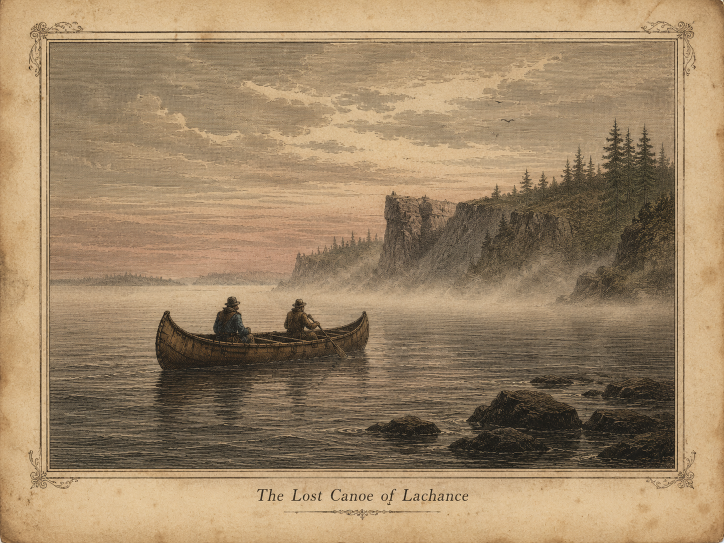
From the field notes of Eleanor Price, Logistics Assistant, and reluctant originator of the Lachance Matter.
I had not yet learned that one should never mention a family name at the Chapter House.
This was my first mistake.
My second was mentioning that my grandmother’s people had been Lachances, or La Chances, depending on which record was being difficult.
I meant it casually. A fragment. One of those family names that survives in kitchen stories, parish records, and the backs of old photographs. A name that had come down through time carrying less information than feeling.
Alistar Corvus heard it from across the room.
“Lachance,” he said.
Charts Whitcomb looked up from a folded map of Green Bay.
Klara Weiss closed her notebook, then opened it again with visible regret.
“Damn it,” she said. “That’s going in the minutes.”
By the end of the hour, the Order of the Great Fifth Sea had formed a special committee.
Its official name was the Committee on Lachance, Ancestral Watercraft, and Unverified Canoe Losses.
Its unofficial name, according to Tom Ashford, was “Canoe Ghosts.”
Dr. Selene Armitage objected immediately.
“We are not doing genealogy by fog machine,” she said.
“No one suggested fog,” Alistar replied.
Tom looked wounded.
“I had a battery-powered option.”
This is how the Order works. One brings them a name, a rumor, a shoreline oddity, or a half-remembered family fragment, and they immediately surround it with procedure. They are never more dangerous than when trying to be respectful.
The problem was not that anyone had proof.
The problem was that no one had enough proof to stop them.
The name Lachance sat there, half French, half family, all invitation. In French, la chance can mean luck, chance, or fortune, depending on who is translating and how badly they want the translation to matter.
Charts wanted it to matter very badly.
Within twenty minutes he had located, or claimed to have located, a reference to something he called “the Lachance canoe.” This reference appeared in what he described as “a secondary rendering of a possibly primary notation,” which meant none of us were allowed to see the original.
Selene asked whether this “lost canoe of Lachance” referred to a person named Lachance, a canoe named La Chance, or a phrase meaning “the lucky canoe.”
Charts adjusted his spectacles.
“Yes,” he said.
Klara wrote: Ambiguity has been accepted as operational guidance.
That was the beginning of the expedition.
Not as history, exactly. Not as genealogy either. More as an interpretive littoral inquiry into the possibility that a name might drift through time the way a paddle drifts after a wreck, separated from the hand but still suggesting direction.
Alistar insisted that we avoid making claims.
“We will not say there was a Lachance at La Baye,” he said.
“Good,” Selene replied.
“We will merely say the name is ancestrally resonant with the French water routes of the upper Great Lakes.”
“That is worse.”
“It is more precise.”
“It is more evasive.”
“Precision often is.”
Klara wrote: The committee has entered the marsh.
The plan was simple, which should have terrified everyone.
We would travel toward Green Bay, the old French La Baye, and consider the region as the French first encountered it: not as a city, not as a football shrine, not as a county map, but as water, passage, danger, trade, diplomacy, and already-inhabited geography.
Selene made that last point three times.
“The French did not discover Green Bay,” she said. “They entered a world already dense with people, routes, agreements, rivalries, memory, and meaning. The bay did not begin when someone from Europe got damp near it.”
Alistar nodded solemnly.
“Agreed.”
Charts nodded too, though he was holding a laminated restaurant placemat and tracing the shoreline with a pencil.
“What is that?” Selene asked.
“A supplemental chart.”
“It has a fish boil coupon on it.”
“Which establishes local confidence.”
Klara wrote: The placemat has been admitted but not trusted.
The Door Peninsula complicates a person’s sense of arrival. On a modern map it looks like a vacation finger pointing into Lake Michigan. In older water logic, it was less decorative. It was a hinge. A limestone blade. A divider of waters. A place where routes opened and weather changed its mind.
You do not really understand Door County from a car window, pleasant as that can be. You understand it from the water, where the lake is not scenery but authority.
That was Alistar’s phrase.
“The lake is authority.”
Tom liked it so much he suggested putting it on a sticker.
Selene refused to let us print anything until we stopped calling the project “The Lachance Route.”
“But it has energy,” Charts said.
“It has no evidence.”
“Energy often precedes evidence.”
“That sentence is why historians drink.”
The alleged route, such as it was, took shape through committee pressure. Charts proposed a line from the lower bay toward the Door side, then along a shore he called “plausible, if emotionally corrected.” Tom proposed adding sensor equipment. Alistar proposed a ceremonial reading. Edwin Barlow proposed period-adjacent attire, by which he meant wool, brass buttons, and shoes no living person should wear near wet limestone.
Selene proposed sandwiches.
This was the only motion passed unanimously.
By late morning we had assembled at the dock with a canoe, two dry bags, three maps, one ceremonial paddle, one unauthorized sonar device, and a folder labeled:
LACHANCE: PROBABLE ROUTES AND EMOTIONAL BEARINGS
Klara stared at it.
“Who made that?”
Charts looked away.
Tom raised his hand.
“I printed it.”
“Why?”
“For morale.”
The canoe itself was not historic. It was not even especially dignified. It had scuffs, a suspicious patch near the stern, and the faded confidence of recreational plastic. Tom had added a small mount for a camera, a safety line, and what he called “interpretive instrumentation.”
Selene pointed to a compact black device near the bow.
“Is that the sonar?”
“It is not only sonar.”
“What else is it?”
“Ancestral context.”
Alistar approved this phrasing too quickly.
We launched under a sky that could not decide whether it wanted to bless or punish us.
For the first twenty minutes, the expedition had the look of competence. This is often the most dangerous phase of any Order activity. Charts sat forward, comparing the shoreline against his maps. Alistar stood aboard The Concord in a dark coat that made him look like the admiral of a private weather system. Selene kept us honest. Klara kept the minutes. Tom kept touching wires.
The bay, meanwhile, did not care.
This is the first lesson of any Great Lakes inquiry.
The water is older than your premise.
Alistar began the ceremonial reading once we had reached what Charts described as a “reasonable zone of ancestral uncertainty.”
“Today,” he said, “we consider the name Lachance not as a claim, but as a vessel. Not as proof, but as passage. Not as possession, but as inquiry.”
Selene gave him a look.
“That is dangerously close to beautiful,” she said.
“I apologize.”
“Continue.”
He did.
He spoke of the French arrival at La Baye, of names traveling by canoe, of priests and traders and interpreters and clerks, of all the minor people who entered the records only briefly, if at all. He spoke of how famous names tend to crowd the doorway of history. Nicolet. Marquette. Joliet. La Salle. But behind them were paddlers, translators, cooks, guides, porters, wives, children, and unnamed laborers whose lives were no less real because fewer people wrote them down.
Then he paused and looked toward the Door Peninsula.
“A person can inherit a name,” he said, “without inheriting the story that carried it.”
That was when Tom dropped the ceremonial paddle.
It did not sink immediately. It bobbed once, with what felt like judgment.
“Lachance,” Charts whispered.
“No,” Selene said.
“The timing is suggestive.”
“The timing is your fault.”
Tom reached for it with a boat hook, missed, and struck the side of the canoe, which rotated with slow comic despair.
Klara wrote: At 11:43 a.m., symbolic watercraft became literal.
For several minutes the expedition degraded into rope work, blame assignment, and French pronunciation.
Charts shouted, “À bâbord!”
Tom shouted, “Use normal boat words!”
Alistar shouted, “Recover the paddle with dignity!”
Selene shouted, “Dignity is no longer available!”
A nearby kayaker slowed just enough to ask whether we were with a theater group.
Klara looked up from the minutes.
“Not officially,” she said.
We did recover the paddle.
We did not recover dignity.
The canoe drifted broadside in the light chop while Tom explained that the situation remained “within tolerance,” which it did not. Charts tried to mark the recovery location on his placemat. Selene took the pencil from him. Alistar, to his credit, said nothing for a while.
That silence gave the bay room to speak in its own way.
Not with words. The lake is mercifully free of our need to explain itself. It spoke in the slap against the hull, the long low color of the horizon, the gulls turning over the break in the weather, the Door Peninsula stretched faint and green to the east. It spoke in the old fact that water remembers movement better than people remember names.
Family history is rarely a clean archive. It is more often a wet ledger, a mistranscribed surname, a parish record with three spellings, a story told once by an aunt and then half-lost in a kitchen. It is not a marble line back through time. It is a shoreline in fog.
You walk it by attention, not certainty.
That was what Selene finally said when the paddle had been retrieved and Tom had stopped apologizing to the equipment.
“Maybe Lachance matters because we cannot prove too much,” she said. “Maybe the point is not whether a specific man in a specific canoe passed here exactly as we imagine. Maybe the point is that names like this remind us how many lives moved through these waters without becoming monuments.”
Alistar nodded.
“The lost canoe as a category.”
Selene considered this.
“Fine. But not as a claim.”
“As a caution?”
“As a caution.”
Charts folded the fish boil placemat.
This was taken as growth.
We returned before dusk, damp in the usual places and humbled in several new ones. The committee met again at the Chapter House, where Klara produced the official findings.
They read as follows:
Finding One: The existence of a specific Lachance canoe remains unverified.
Finding Two: The name Lachance remains ancestrally resonant, historically suggestive, and procedurally dangerous.
Finding Three: The French arrival at La Baye must not be described as discovery. It was an entry into an existing Indigenous world of water knowledge, trade, diplomacy, and memory.
Finding Four: The placemat is not a map.
Charts objected.
His objection was not recorded.
Finding Five: The canoe, whether literal, symbolic, mistranslated, or family-born, is considered lost but not gone.
That was the one that stayed with me.
Lost but not gone.
There are things in a family line that cannot be proven into neatness. A name survives. A rumor surfaces. A place pulls at you. You stand near the water and feel, not certainty, but pressure. The sense that someone before you also looked across a gray bay and wondered what could be carried, what could be lost, and what might somehow arrive anyway.
We never found the canoe of Lachance.
Of course we did not.
I am not even sure, in the strictest sense, that there was one to find.
But by evening the bay had gone silver, and the Door Peninsula sat low on the horizon like a thought refusing to finish itself. Alistar stood quietly at the rail. Selene said nothing. Even Tom had stopped adjusting the equipment.
I thought of my grandmother’s name moving backward through records, changing shape as it went.
Lachance.
La Chance.
Luck.
Fortune.
Chance.
Not proof.
A vessel.
Maybe that is what family history is most of the time: not the recovery of certainty, but the act of putting a hand on the old wood and admitting that something carried you here.
